

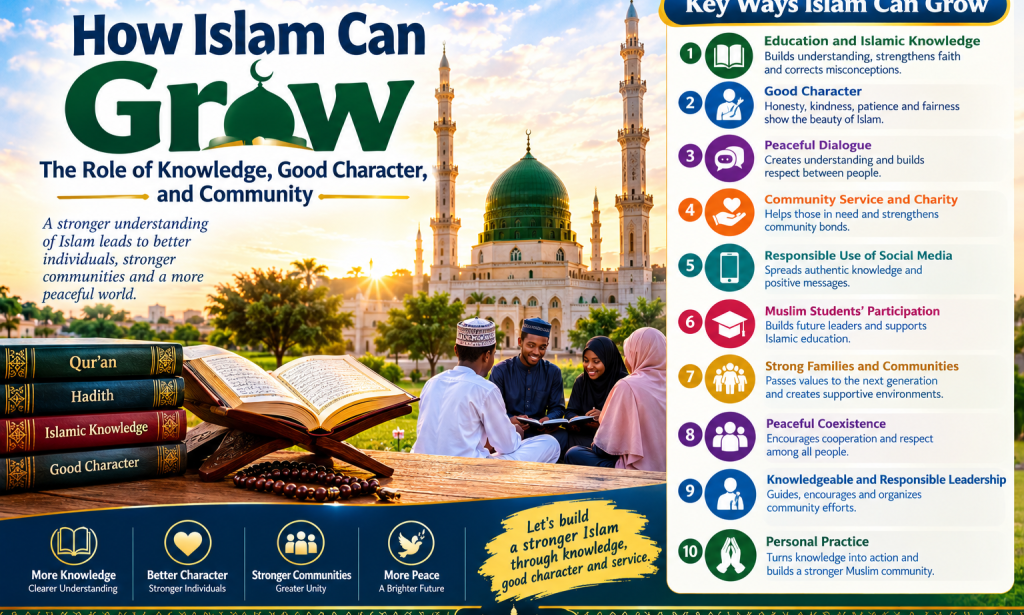
How Islam Can Grow: The Role of Knowledge, Good Character, and Community
Introduction
Islam is one of the world's major religions, with Muslim communities across different countries, cultures, and societies. Throughout history, Islam has spread through various means, including teaching, trade, migration, scholarship, and the personal example of Muslim communities.
The growth of Islam can be understood in different ways: an increase in the number of Muslims, a deeper understanding of Islamic teachings among believers, stronger Muslim communities, and greater public awareness of Islam. Knowledge, good character, peaceful dialogue, and community service can all contribute to these forms of growth.
1. Through Education and Islamic Knowledge
Education is an important foundation for understanding Islam. Muslims can strengthen their faith by studying the Qur'an, learning about the life of Prophet Muhammad (peace be upon him), and seeking reliable explanations of Islamic teachings.
Mosques, Islamic schools, educational organizations, and student associations can help provide opportunities for learning.
When people understand their religion more clearly, they can explain their beliefs accurately and respond to questions with knowledge rather than misunderstanding.
2. Through Good Character
One meaningful way Muslims can represent Islam is through their conduct.
Honesty, kindness, patience, humility, fairness, and keeping promises are qualities emphasized in Islamic teachings. When Muslims demonstrate these values in everyday life, they can help others develop a more informed understanding of their faith.
For example, a student who treats classmates fairly, refuses to cheat, respects teachers, and helps others demonstrates positive character in practical ways.
Good conduct does not require pressuring anyone to accept a religion. It allows people to learn through respectful interaction and personal example.
3. Through Peaceful Dialogue
Respectful conversations can help people understand Islam and clear up misconceptions.
Muslims can explain their beliefs when others express genuine interest, answer questions honestly, and acknowledge when they need to consult a knowledgeable source.
Listening is just as important as speaking. People have different experiences, religious backgrounds, and questions, so conversations should be patient and respectful.
Healthy dialogue encourages understanding without insults, hostility, or coercion.
4. Through Community Service and Charity
Helping people in need can strengthen community relationships and demonstrate Islamic values in action.
Muslims can contribute through charitable donations, educational support, food assistance, environmental cleanliness, and volunteering.
These activities can benefit people regardless of their religious background. Community service also creates opportunities for cooperation and friendship between different groups.
5. Through the Responsible Use of Social Media
Social media offers opportunities to share educational information about Islam with people in different places.
Muslims can use platforms such as WhatsApp, YouTube, Facebook, and Instagram to share Qur'anic lessons, discussions about Islamic history, educational articles, and reminders about good character.
However, information should be checked before publication. Incorrect religious quotations, misleading claims, and disrespectful arguments can create confusion rather than understanding.
Responsible communication should prioritize accuracy, kindness, and respect for other people's privacy and beliefs.
6. Through the Work of Muslim Students
Muslim students can contribute to the growth of Islamic knowledge within their schools and communities.
Organizations such as the Muslim Students' Society of Nigeria (MSSN) may provide opportunities for Islamic lectures, Qur'an study, academic support, leadership training, and community outreach.
Students can participate by attending educational programmes, helping organize beneficial activities, and encouraging their peers to pursue knowledge and good character.
Such participation can strengthen both personal development and the educational life of the wider community.
7. Through Strong Families and Communities
Families play an important role in passing religious knowledge and values from one generation to another.
Parents and guardians can help children learn about Islam through age-appropriate education, good examples, open discussions, and participation in community activities.
Mosques and community organizations can also provide learning opportunities for young people and adults.
Welcoming environments where people can ask questions without fear of ridicule can help learners develop a clearer understanding of their faith.
8. Through Peaceful Coexistence
Muslims live alongside people of different religions and beliefs. Respectful relationships are therefore important for community life.
Cooperation on shared concerns, such as education, public health, environmental protection, and helping vulnerable people, can build trust between communities.
Muslims can remain committed to their beliefs while respecting other people's rights and freedom of conscience.
Religious growth should be based on informed choice and sincere conviction rather than intimidation or force.
9. Through Knowledgeable and Responsible Leadership
Teachers, scholars, community leaders, and student coordinators can support Islamic learning by providing accurate information and encouraging constructive activities.
Responsible leaders should welcome sincere questions, correct mistakes, promote peaceful relationships, and encourage young people to develop their skills.
They can also help community organizations become more inclusive, organized, and responsive to the educational and social needs of their members.
10. Through Personal Practice
The growth of a religious community also depends on the commitment of its members to learning and practising their beliefs.
Muslims can work on their personal development by observing their religious obligations, studying Islamic teachings, correcting harmful habits, treating others fairly, and fulfilling their responsibilities.
Personal practice and community participation can reinforce one another, helping believers build communities centered on knowledge, service, and mutual respect.
Conclusion
Islam can grow in different ways, including through increased understanding of its teachings, the development of stronger communities, and the voluntary interest of people who wish to learn about the religion.
Education, good character, peaceful dialogue, charity, responsible social media use, and community service can all contribute to these goals.
Ultimately, meaningful religious growth involves more than numbers. It also involves knowledge, sincerity, ethical conduct, and respect for others. By embodying these principles, Muslims can contribute positively to their communities while allowing people to make their own informed religious choices.


You must be logged in to post a comment.