

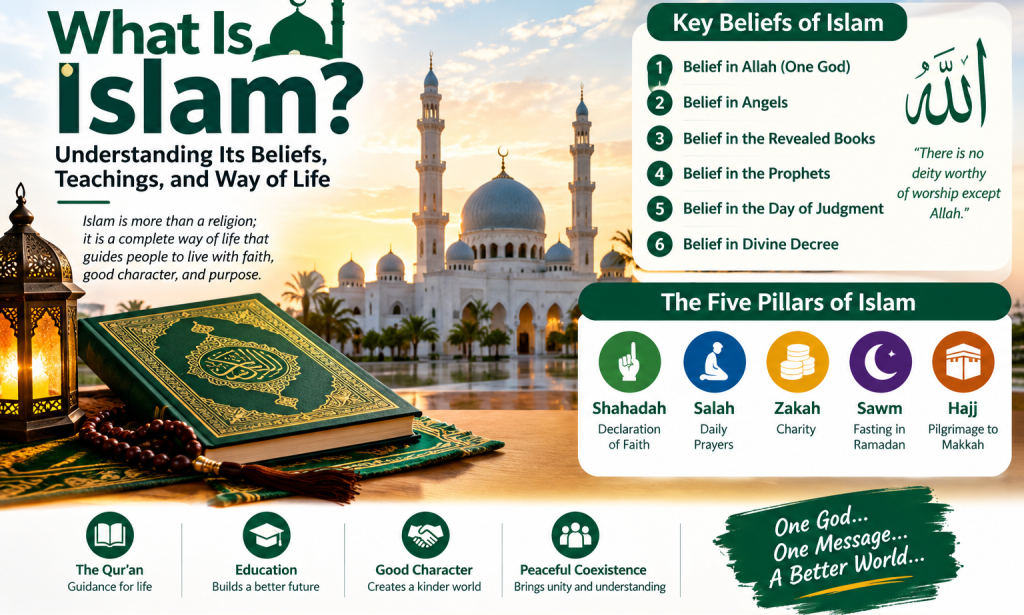
What Is Islam? Understanding Its Beliefs, Teachings, and Way of Life
Introduction
Islam is one of the world's major religions, with followers known as Muslims. It teaches belief in one God, called Allah in Arabic, and encourages people to live with honesty, kindness, justice, patience, and compassion. Islam provides guidance on worship, personal conduct, family relationships, and responsibilities toward other people.
Understanding Islam helps readers appreciate its beliefs, practices, history, and contributions to society.
What Is Islam?
Islam is a monotheistic religion, meaning that Muslims believe in only one God, Allah, who created and sustains the universe.
The word Islam is commonly understood as submission to God, while the related Arabic word salaam means peace. Muslims believe that following God's guidance helps people develop a meaningful life built on faith, good character, and responsibility.
Islam began in seventh-century Arabia through the prophetic mission of Muhammad (peace be upon him), whom Muslims regard as God's final prophet. Muslims also believe in earlier prophets, including Adam, Nuh (Noah), Ibrahim (Abraham), Musa (Moses), and Isa (Jesus), peace be upon them all.
The Main Beliefs of Islam
Islam has several fundamental beliefs that guide the lives of Muslims.
1. Belief in Allah
Muslims believe that Allah is one, without partner or equal. Worship is directed to Allah alone, and believers are encouraged to remember Him and follow His guidance.
2. Belief in Angels
Muslims believe that angels are created by Allah and carry out tasks assigned to them.
3. Belief in the Revealed Books
Muslims believe that Allah revealed guidance through scriptures to earlier prophets. They regard the Qur'an as the final revealed scripture and the central religious text of Islam.
4. Belief in the Prophets
Muslims believe that Allah sent prophets to guide humanity. Prophet Muhammad (peace be upon him) is regarded as the final prophet in Islam.
5. Belief in the Day of Judgment
Muslims believe that people will be accountable to Allah for their deeds. This belief encourages responsibility, justice, and good conduct.
6. Belief in Divine Decree
Muslims believe in Allah's knowledge and decree while recognizing human responsibility for choices and actions.
The Five Pillars of Islam
The Five Pillars are central acts of worship and practice in Islam.
1. Shahadah — Declaration of Faith
This is the testimony that there is no deity worthy of worship except Allah and that Muhammad is the Messenger of Allah.
2. Salah — Daily Prayers
Muslims are required to perform five daily prayers at prescribed times. Prayer strengthens their relationship with Allah and encourages discipline.
3. Zakah — Obligatory Charity
Eligible Muslims give a prescribed portion of qualifying wealth to those entitled to receive it. Zakah promotes social responsibility and helps support people in need.
4. Sawm — Fasting During Ramadan
Adult Muslims who are able to fast generally abstain from food, drink, and other things that invalidate the fast from dawn until sunset during Ramadan. Recognized exemptions apply in certain circumstances.
5. Hajj — Pilgrimage to Makkah
Muslims who are physically and financially able are required to perform Hajj at least once in their lifetime.
The Qur'an and Its Importance
The Qur'an is the holy book of Islam. Muslims believe it contains the words of Allah revealed to Prophet Muhammad (peace be upon him).
It addresses worship, morality, justice, family life, patience, gratitude, and care for others. Muslims recite the Qur'an during prayers and study its teachings to understand how to live according to their faith.
The Sunnah, which records the teachings, practices, and example of Prophet Muhammad, is another important source of Islamic guidance.
Islam and Good Character
Islam places considerable emphasis on good character. Muslims are encouraged to tell the truth, respect their parents, keep promises, care for neighbours, help people in need, and treat others fairly.
Good character also includes humility, patience, forgiveness, cleanliness, and avoiding dishonesty and injustice.
These values are important not only within religious communities but also in schools, workplaces, families, and society at large.
Islam and Education
Seeking beneficial knowledge is highly valued in Islam. Learning helps people understand their responsibilities, make informed decisions, and contribute positively to their communities.
Muslim students are encouraged to combine their religious education with academic learning, develop effective study habits, respect their teachers, and use their knowledge responsibly.
Organizations such as the Muslim Students' Society of Nigeria (MSSN) can provide opportunities for Islamic learning, educational support, leadership development, and friendship among students.
Islam and Peaceful Coexistence
Islam teaches justice, kindness, and responsible conduct toward others. Muslims live in diverse societies alongside people of different religions, cultures, and backgrounds.
Respectful dialogue, fairness, cooperation, and peaceful coexistence can help communities build mutual understanding. People should not be judged solely by their religious identity; their individual actions and conduct also matter.
Conclusion
Islam is a religion centered on belief in one God, worship, moral responsibility, and guidance for everyday life. Its fundamental beliefs and Five Pillars provide a framework for Muslim faith and practice, while its teachings emphasize knowledge, justice, compassion, and good character.
Learning about Islam can help readers better understand Muslim beliefs and appreciate the importance of respect and understanding among people of different backgrounds.


You must be logged in to post a comment.