
📌 Table of Contents
- Introduction
- Overview of the Nigerian Education System
- What Changed in the New Nigerian Curriculum?
- Goals of the Updated NERDC Curriculum
- Structure of the Nigerian School System
- Nursery and Primary School Education in Nigeria
- Primary School Subjects in Nigeria
- Importance of Primary Education
- ICT and Digital Literacy in Primary Schools
- Junior Secondary School (JSS1–JSS3) Curriculum
- Core Subjects in Junior Secondary School
- Pre-Vocational and Trade Subjects in JSS
- BECE Examination and Junior Secondary Education
- Senior Secondary School (SS1–SSS3) Curriculum
- Core Compulsory Subjects in Senior Secondary School
- Science Subjects and Career Pathways
- Arts Subjects and Humanities Career Opportunities
- Commercial Subjects and Business Career Opportunities
- Trade Subjects and Entrepreneurship Education
- Why Trade Subjects Matter in the New Curriculum
- Digital Technology and ICT Education
- Benefits of the New Nigerian Curriculum
- Challenges Facing Curriculum Implementation
- The Role of Parents and Teachers
- WAEC, NECO and University Preparation
- How Students Can Succeed Under the New Curriculum
- Frequently Asked Questions (FAQs)
- Conclusion
1. Introduction
Nigeria’s education sector has continued to experience major reforms aimed at improving learning quality, reducing excessive theoretical education, and preparing students for real-world opportunities.
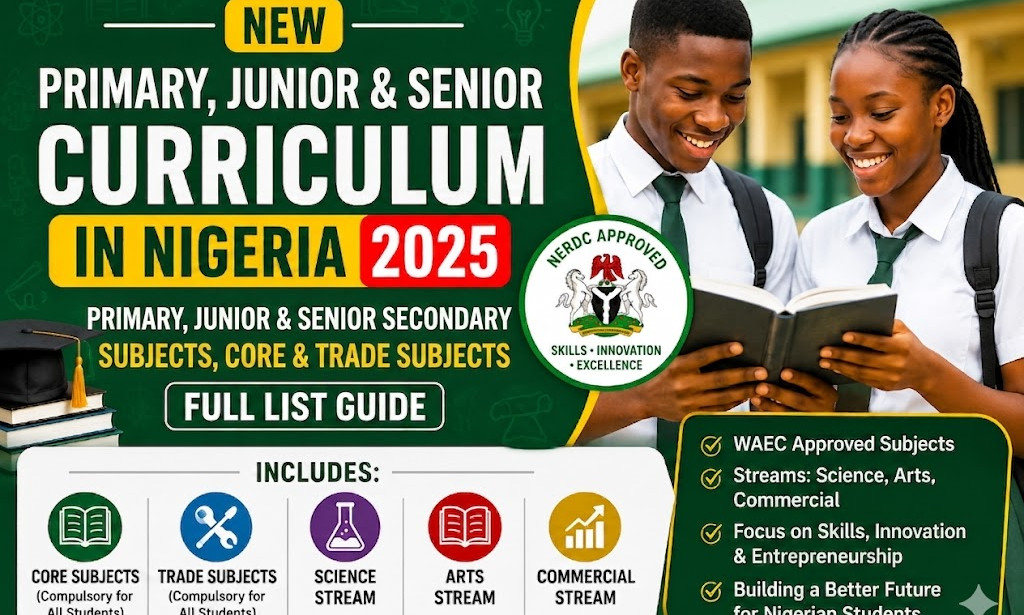
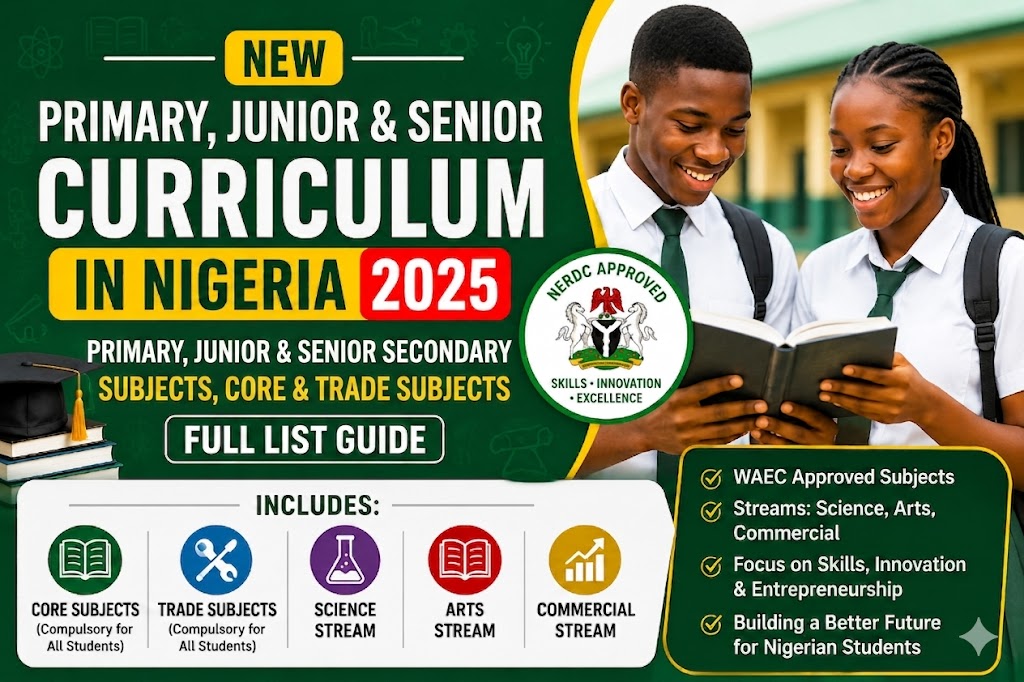
Recent curriculum updates coordinated by the Nigerian Educational Research and Development Council (NERDC) introduced stronger emphasis on entrepreneurship, digital literacy, practical learning, vocational studies, and career development across primary, junior secondary, and senior secondary school levels.
The revised curriculum is designed to help Nigerian students become academically sound while also developing practical skills that can support employment, innovation, and self-reliance in the future.
Across schools in Nigeria, pupils and students now learn through a more structured educational system that combines academics with creativity, technology, civic responsibility, and entrepreneurship.
This guide explains the complete structure of the Nigerian school curriculum from primary school to senior secondary education, including core subjects, trade subjects, stream specialization, and examination requirements.
2. Overview of the Nigerian Education System
Nigeria operates a structured educational system divided into three major stages:
📘 Primary Education
This includes:
- Nursery education
- Primary 1–6
Primary education focuses on foundational literacy, communication, numeracy, and social development.
📗 Junior Secondary Education
This includes:
- JSS1
- JSS2
- JSS3
At this level, students begin practical learning, pre-vocational education, and preparation for BECE examinations.
📙 Senior Secondary Education
This includes:
- SS1
- SS2
- SS3
Students specialize in:
- Science
- Arts/Humanities
- Commercial/Business
They also prepare for:
- WAEC
- NECO
- JAMB
- tertiary education admission
3. What Changed in the New Nigerian Curriculum?
The recent curriculum reform introduced several important changes across Nigerian schools.
Some of the major improvements include:
- Increased focus on practical learning
- Expansion of ICT and digital literacy
- Entrepreneurship and vocational education
- Reduction of unnecessary subject overload
- Better career preparation
- Stronger civic and moral education
- More student-centered learning methods
The goal is to produce students who are:
- Creative
- Innovative
- Employable
- Skilled
- Independent thinkers
4. Goals of the Updated NERDC Curriculum
The revised curriculum aims to:
- Improve learning quality
- Promote critical thinking
- Encourage innovation
- Develop entrepreneurship skills
- Prepare students for modern careers
- Strengthen national values and citizenship
- Improve science and technology education
The reforms also align Nigerian education more closely with global educational standards.
5. Structure of the Nigerian School System
The curriculum structure is organized to gradually develop students from foundational learning to career specialization.
✔ Primary School
Foundational education and literacy development.
✔ Junior Secondary School
Introduction to vocational learning, technology, and broader academic subjects.
✔ Senior Secondary School
Career specialization through subject streams and trade education.
6. Nursery and Primary School Education in Nigeria
Primary education is the most important foundation in a child’s academic journey.
At this stage, children develop:
- Reading and writing skills
- Communication abilities
- Numeracy
- Social interaction
- Creativity
- Moral values
The curriculum also introduces pupils to basic science, arts, and technology.
7. Primary School Subjects in Nigeria
Common primary school subjects include:
📘 English Language
Pupils learn:
- Reading
- Grammar
- Writing
- Vocabulary
- Communication skills
📗 Mathematics
Topics include:
- Addition and subtraction
- Fractions
- Measurement
- Geometry
- Multiplication and division
🔬 Basic Science and Technology
Children learn:
- Living things
- The environment
- Human body basics
- Energy and simple machines
🌍 Civic Education
Topics include:
- Respect
- National values
- Good behavior
- Community living
🎭 Cultural and Creative Arts
Pupils participate in:
- Music
- Drawing
- Crafts
- Drama
💻 ICT / Computer Studies
Children are introduced to:
- Basic computer knowledge
- Keyboard skills
- Digital awareness
- Educational technology
8. Importance of Primary Education
Primary education:
- Builds literacy and numeracy foundations
- Improves communication skills
- Develops discipline and confidence
- Encourages creativity
- Prepares children for secondary education
Without strong primary education, students often struggle in later academic stages.
9. ICT and Digital Literacy in Primary Schools
Technology now plays a major role in Nigerian education.
The curriculum encourages:
- Computer awareness
- Digital communication
- Basic internet understanding
- Educational software usage
This helps pupils become familiar with technology from an early age.
10. Junior Secondary School (JSS1–JSS3) Curriculum
Junior secondary school represents the transition from basic foundational learning to broader academic and practical education.
Students study:
- Core academic subjects
- Vocational subjects
- ICT
- Civic education
- Cultural studies
JSS3 students also prepare for the Basic Education Certificate Examination (BECE).
11. Core Subjects in Junior Secondary School
📘 English Studies
Students learn:
- Essay writing
- Grammar
- Oral English
- Comprehension
📗 Mathematics
Topics include:
- Algebra
- Geometry
- Statistics
- Fractions
🔬 Basic Science and Technology
This combines:
- Biology basics
- Chemistry introduction
- Physics concepts
- Introductory technology
🌍 Social Studies
Students learn:
- National unity
- Citizenship
- Governance
- Culture and society
12. Pre-Vocational and Trade Subjects in JSS
Practical learning is heavily emphasized.
Subjects may include:
- Agricultural Science
- Home Economics
- Basic Technology
- Fashion Design
- Catering Craft Practice
- Electrical Installation
- Carpentry
- Hairdressing
These subjects help students discover talents and practical skills early.
13. BECE Examination and Junior Secondary Education
At the end of JSS3, students write the Basic Education Certificate Examination (BECE).
Subjects examined commonly include:
- English
- Mathematics
- Basic Science
- Social Studies
- Civic Education
- ICT
- Home Economics
- Basic Technology
Performance determines promotion into senior secondary school.
14. Senior Secondary School (SS1–SSS3) Curriculum
Senior secondary education allows students to specialize in career pathways.
The curriculum is divided into:
- Science
- Arts/Humanities
- Commercial/Business
Students also prepare for:
- WAEC
- NECO
- JAMB
15. Core Compulsory Subjects in Senior Secondary School
All students study:
- English Language
- Mathematics
- Civic Education
- ICT / Digital Technology
- Trade or entrepreneurship subjects
These subjects are essential regardless of career stream.
16. Science Subjects and Career Pathways
Science students typically study:
- Physics
- Chemistry
- Biology
- Agricultural Science
- Further Mathematics
Career opportunities:
- Medicine
- Engineering
- Nursing
- Pharmacy
- Computer Science
17. Arts Subjects and Humanities Career Opportunities
Arts students may study:
- Literature in English
- Government
- CRS / IRS
- History
- Languages
Career opportunities:
- Law
- Journalism
- Public Administration
- Teaching
- International Relations
18. Commercial Subjects and Business Career Opportunities
Commercial students focus on:
- Accounting
- Economics
- Commerce
- Marketing
- Business Studies
Career opportunities:
- Banking
- Accounting
- Entrepreneurship
- Business Administration
19. Trade Subjects and Entrepreneurship Education
Trade subjects are becoming increasingly important in Nigerian schools.
Examples include:
- Fashion Design
- Photography
- Catering
- Plumbing
- Electrical Installation
- GSM Repairs
- Woodwork
The aim is to reduce unemployment and encourage self-reliance.
20. Why Trade Subjects Matter in the New Curriculum
Trade subjects:
- Encourage practical skills
- Promote entrepreneurship
- Reduce overdependence on white-collar jobs
- Prepare students for vocational careers
- Support creativity and innovation
21. Digital Technology and ICT Education
ICT is now integrated across educational levels.
Students learn:
- Computer operations
- Internet use
- Digital communication
- Basic coding concepts
- Online safety
Digital literacy is considered essential in modern education.
22. Benefits of the New Nigerian Curriculum
The revised curriculum:
- Improves practical learning
- Encourages creativity
- Supports entrepreneurship
- Builds technology skills
- Prepares students for modern careers
- Reduces excessive theory-based learning
23. Challenges Facing Curriculum Implementation
Despite improvements, challenges remain:
- Inadequate ICT facilities
- Poor funding
- Teacher shortages
- Limited vocational equipment
- Unequal implementation across states
24. The Role of Parents and Teachers
Parents and teachers play critical roles in student success.
Parents should:
- Encourage learning
- Monitor study habits
- Support skill development
Teachers should:
- Use practical teaching methods
- Encourage creativity
- Guide students academically and morally
25. WAEC, NECO and University Preparation
Senior secondary education prepares students for:
- WAEC
- NECO
- JAMB
- university admission
Subject combinations are important for future career opportunities.
26. How Students Can Succeed Under the New Curriculum
Students can succeed by:
- Studying consistently
- Taking practical learning seriously
- Developing digital skills
- Participating in trade subjects
- Seeking career guidance early
27. Frequently Asked Questions (FAQs)
1. Who developed the revised curriculum?
The curriculum was developed by NERDC in collaboration with the Federal Ministry of Education.
2. Are trade subjects compulsory?
Trade and entrepreneurship education are now strongly emphasized in schools.
3. What exam do JSS3 students write?
Students write the BECE examination.
4. What exams do SS3 students write?
WAEC, NECO, and sometimes NABTEB.
5. Does the curriculum include ICT?
Yes, digital literacy is now a major focus.
28. Conclusion
The revised Nigerian school curriculum represents a major effort to modernize education and prepare students for future opportunities.
By combining academics with technology, entrepreneurship, vocational training, and practical learning, the curriculum aims to produce students who are knowledgeable, innovative, and self-reliant.
From primary school to senior secondary education, the system now focuses not only on passing examinations but also on helping students develop real-world skills that can support personal growth, employment, and national development.
As implementation continues to improve across Nigeria, the updated curriculum has the potential to positively transform the future of education in the country.


You must be logged in to post a comment.