

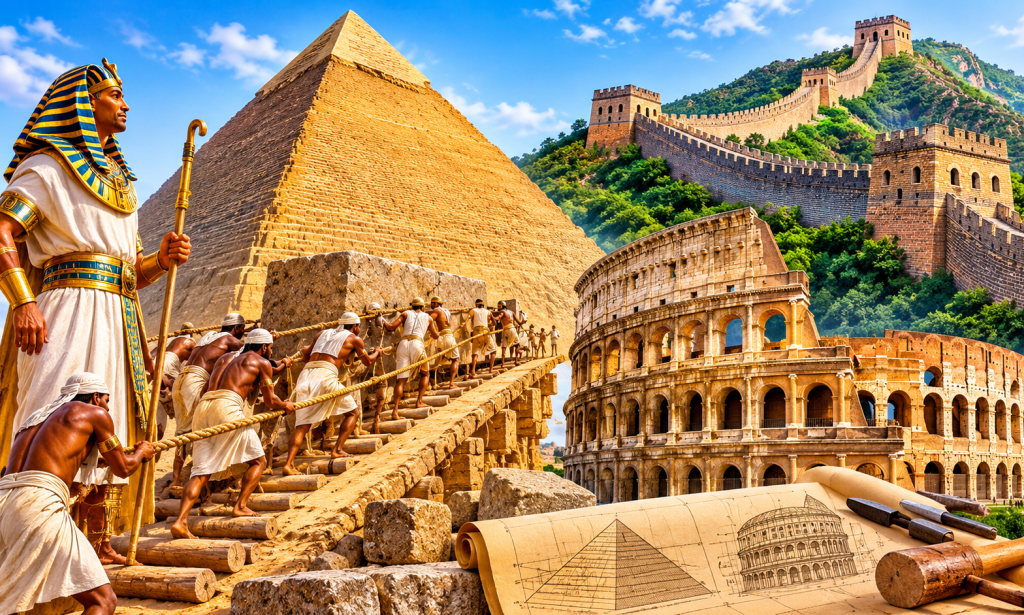
How Ancient People Built Structures That Still Stand Today
Thousands of years ago, people built enormous structures without modern machines, electric tools, cranes or advanced construction technology. Surprisingly, some of these buildings are still standing today, attracting visitors and researchers from different parts of the world.
From the Egyptian pyramids to the Great Wall of China, ancient civilizations left behind architectural wonders that continue to amaze the modern world.
But how did people who lived thousands of years ago accomplish such incredible construction projects?
Let's explore some of the secrets behind their achievements.
1. They Used Strong and Durable Materials
One of the major reasons some ancient buildings have survived for so long is the materials used during construction.
Ancient builders worked with granite, limestone, sandstone, clay bricks and other natural materials.
They carefully selected materials based on their availability and suitability for different construction projects.
For example, ancient Egyptian builders used limestone and granite to construct their famous pyramids. These stones were strong enough to withstand centuries of exposure to the environment.
2. They Had Advanced Knowledge of Mathematics
Although ancient civilizations did not have modern computers or calculators, they understood mathematics and geometry.
They used measurements, calculations and careful planning to determine the height, width, angles and proportions of their buildings.
This knowledge helped them construct stable structures that could support enormous weights.
Their understanding of mathematics was especially important when constructing temples, pyramids and monuments.
3. They Built Without Modern Machines
One of the biggest mysteries surrounding ancient construction is how workers moved enormous stones without modern equipment.
Ancient builders used tools such as wooden rollers, ropes, ramps, levers and sledges to transport heavy materials.
They also relied on organized teams of workers who performed different tasks during construction.
Although researchers continue to investigate some construction methods, archaeological discoveries have provided evidence of the clever techniques used by ancient builders.
4. The Egyptian Pyramids: A Wonder That Survived Thousands of Years
The Egyptian pyramids are among the most remarkable achievements of ancient civilization.
The Great Pyramid of Giza was constructed more than 4,500 years ago during the reign of Pharaoh Khufu.
It was built using millions of stone blocks and required extraordinary planning, organization and engineering skills.
The pyramid was originally about 146.6 metres tall, making it the tallest human-made structure in the world for thousands of years.
Today, it remains one of the most famous historical monuments on Earth.
5. The Great Wall of China: An Extraordinary Construction Achievement
The Great Wall of China is another example of ancient engineering.
It was constructed and expanded by different Chinese dynasties over many centuries to protect territories from invading forces.
Builders used materials such as stone, bricks and compacted earth, depending on the region.
The wall stretches across mountains, valleys and difficult landscapes.
Despite centuries of exposure to weather and natural damage, many sections have survived and remain important historical attractions.
6. The Romans Created Buildings That Could Last for Centuries
Ancient Rome was famous for its impressive architecture and engineering.
Roman builders developed construction techniques that included the use of concrete, arches, domes and carefully designed foundations.
One remarkable example is the Colosseum in Rome.
Built nearly 2,000 years ago, it was used for public entertainment and could accommodate tens of thousands of spectators.
Although parts of the building have been damaged by earthquakes, weather and other events, a significant portion remains standing.
Roman construction methods influenced architecture in many parts of the world.
7. They Understood the Importance of Strong Foundations
Ancient builders understood that a building needed a stable foundation to remain standing.
Before construction, they often prepared the ground, selected suitable locations and created foundations capable of supporting heavy structures.
They also designed buildings to distribute weight properly.
This helped reduce the risk of collapse and contributed to the durability of many ancient monuments.
8. They Worked Together and Planned Carefully
Large construction projects required more than physical strength.
They needed architects, builders, stoneworkers, engineers, supervisors and organized labour teams.
Different groups were responsible for transporting materials, preparing construction sites, shaping stones and assembling the structures.
Some projects took many years to complete.
Their ability to organize workers and manage resources was an important part of their success.
9. Not Every Ancient Structure Survived
Although many ancient buildings are still standing, not all survived the passage of time.
Some were destroyed by earthquakes, floods, wars, fires and natural erosion.
Others gradually disappeared because of poor maintenance and environmental damage.
The ancient structures that remain today are examples of successful construction, but their survival also depends on their location, materials, design and preservation.
10. What Modern Builders Can Learn From Ancient Civilizations
Ancient architecture still offers valuable lessons to modern engineers and architects.
The importance of strong foundations, durable materials, careful measurements, good planning and structural balance remains relevant today.
Modern construction uses advanced technology, but many basic engineering principles were understood and applied by ancient civilizations.
Their achievements continue to inspire researchers and construction professionals.
Conclusion
The ancient world was filled with intelligent, creative and hardworking people who achieved extraordinary things with the resources available to them.
Without modern machines, they constructed buildings that have survived for thousands of years.
The Egyptian pyramids, the Great Wall of China and the Roman Colosseum are reminders that human creativity and engineering knowledge existed long before modern technology.
These structures are not simply old buildings. They are lasting evidence of the intelligence, determination and remarkable abilities of ancient civilizations.











































You must be logged in to post a comment.