
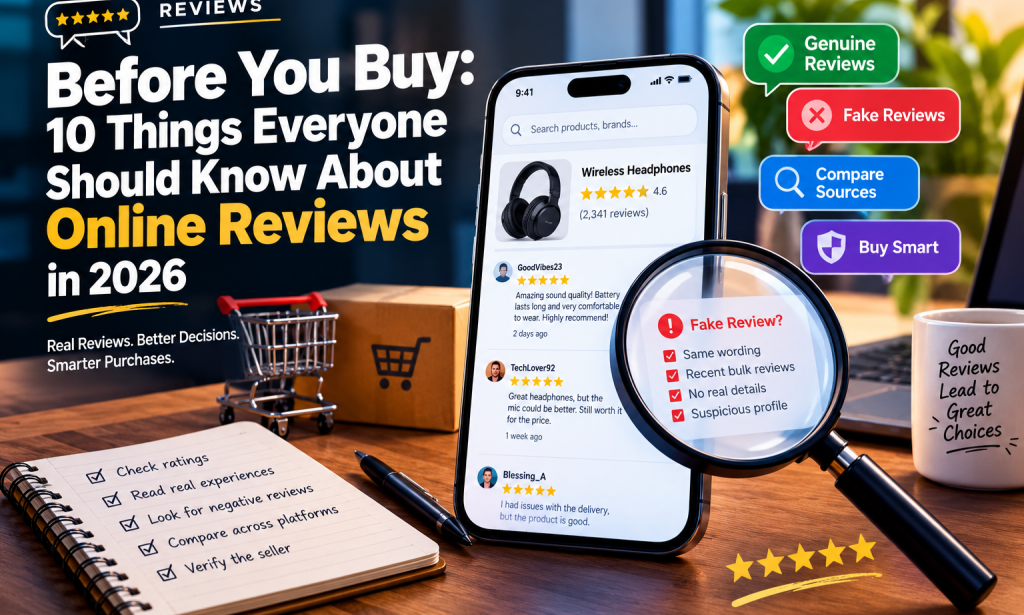
Before You Buy: 10 Things Everyone Should Know About Online Reviews in 2026
Imagine finding a smartphone online with a five-star rating, hundreds of glowing comments, and a price that seems too good to be true. You feel excited and almost ready to buy it. But after receiving the product, you discover that it performs nothing like the reviews promised.
Sounds frustrating, right?
This is why online reviews matter—and why learning to evaluate them is more important than ever.
From smartphones and fashion to restaurants, games, websites, and everyday household products, customer reviews can help people decide what deserves their money. A useful review can reveal details that advertisements often leave out, including a product's weaknesses, durability, ease of use, and overall value.
However, not every review tells the complete story. Some may be exaggerated, outdated, biased, or even misleading.
So, how can you separate helpful feedback from unreliable opinions?
Here are ten important things to know before trusting an online review.
1. Don't Judge a Product by Its Star Rating Alone
A five-star rating looks impressive, but it doesn't automatically mean a product is excellent.
Imagine two smartphones. The first has a five-star rating based on only three reviews, while the second has a 4.6-star rating based on hundreds of detailed customer experiences.
Which one should you trust?
Neither rating tells the whole story, but the second phone provides a larger collection of feedback to investigate.
Look beyond the number of stars. Read what customers actually say about performance, quality, reliability, and value for money.
Pay attention to recurring complaints as well as positive comments.
The lesson: Star ratings are useful starting points, not final verdicts.
2. Learn to Recognize Suspicious Reviews
Some online reviews may be fake or manipulated to make a product appear better or worse than it really is.
Certain warning signs deserve attention.
For example, dozens of reviews posted within a short period may deserve closer inspection, especially if they use nearly identical wording.
Comments such as "Amazing product!" or "Best thing ever!" provide little information when they don't explain what the reviewer liked.
Be cautious when several reviews repeat unusual phrases, make unrealistic promises, or appear to describe features that the product doesn't have.
However, one suspicious-looking comment doesn't prove that a review is fake. Genuine customers can also write short or enthusiastic feedback.
The lesson: Look for patterns and supporting evidence rather than making a decision based on one warning sign.
3. Read Negative Reviews Before Making a Decision
Positive reviews can tell you what people enjoy, but negative reviews often reveal potential problems.
A customer might mention that a phone overheats during demanding games, a pair of shoes feels uncomfortable after several hours, or an appliance is difficult to clean.
These details can help you decide whether a product suits your needs.
However, don't automatically reject something because of one negative comment.
Ask yourself three questions:
- Is the complaint repeated by several customers?
- Does the problem affect something important to me?
- Could the issue depend on individual preferences or how the product was used?
For example, a person might complain that a smartphone is too large, while another buyer might prefer a large screen.
The same feature can be a disadvantage for one person and an advantage for another.
The lesson: Negative reviews are most useful when you understand the problem behind the rating.
4. Check Whether the Review Is Recent
A review written several years ago may no longer describe the product accurately.
Manufacturers sometimes update their products, software, prices, or included features. A service may also change its policies or customer support.
For technology products, recent reviews can be especially valuable because software updates may improve or worsen the user experience.
For online services, check whether customers are discussing the current version rather than an older one.
You should also consider the date when comparing prices. A review praising a product's value might have been written when it cost much less.
The lesson: Recent feedback is often more relevant, but older reviews can still reveal long-term reliability and durability.
5. Compare Reviews Across Different Websites
Reading reviews from only one website can give you an incomplete picture.
A seller's product page may contain useful customer feedback, but it is also worth checking independent reviews, specialist publications, and other reputable platforms.
For example, when researching a smartphone, you could compare customer experiences with a detailed review that tests its camera, battery, display, and gaming performance.
Each source offers a different perspective.
Customers can explain how a product performs during everyday use, while experienced reviewers may conduct controlled tests and compare results with competing products.
If several independent sources identify the same weakness, that information deserves attention.
Be careful, however, not to assume that several websites are independent if they simply repeat the same original review.
The lesson: A broader range of credible sources can help you make a more balanced decision.
6. Understand the Difference Between Opinions and Facts
Reviews often combine personal opinions with claims that can be checked.
Consider these two statements:
"I think this phone has a beautiful design."
"This phone has a 6,000mAh battery."
The first statement expresses a personal preference. The second is a factual claim that can be checked against the manufacturer's specifications.
Both types of information can be useful, but they should be evaluated differently.
One person may love a product's appearance while another dislikes it. Neither opinion is automatically wrong.
However, claims about battery capacity, storage, waterproof ratings, ingredients, or product specifications should be supported by reliable information.
When a reviewer makes a technical claim, look for evidence rather than relying entirely on confident wording.
The lesson: Appreciate personal experiences, but verify important factual claims.
7. Be Careful With Influencer Reviews and Sponsored Content
Influencers and content creators can provide entertaining and informative product reviews.
They may demonstrate how a product works, explain its features, and share their personal experiences.
However, some reviews involve sponsorships, affiliate commissions, free products, or other commercial relationships.
These arrangements do not automatically make a review dishonest. A creator can receive compensation and still provide a fair assessment.
The important question is whether the relationship is disclosed and whether the review discusses both strengths and weaknesses.
Be cautious when a reviewer makes dramatic promises, pressures viewers to buy immediately, or refuses to acknowledge obvious limitations.
Compare the creator's claims with other credible sources before spending money.
The lesson: Consider how a reviewer might benefit from your purchase, and look for transparent, evidence-based assessments.
8. Look for Reviews That Explain Real-World Experiences
The most useful reviews often explain what happened when someone actually used a product.
Instead of simply saying that a smartphone is excellent, a detailed review might describe how long its battery lasts during ordinary use, how clearly its camera captures photographs, and whether demanding applications run smoothly.
Similarly, a review of a pair of shoes might explain the comfort, materials, durability, and situations in which they work best.
Specific details make it easier to decide whether the product fits your own needs.
Look for reviews that explain the context of the experience, identify both advantages and disadvantages, and avoid making unrealistic promises.
The lesson: Detailed explanations are generally more useful than vague praise.
9. Check the Price, Warranty, and Return Policy
Even a highly rated product may not be the right purchase if the price is unreasonable or the seller offers poor after-sales support.
Before buying, compare prices from reputable sellers and check what is included in the purchase.
For electronics, investigate the warranty, repair options, and whether the device is new, refurbished, or used.
For clothing, check sizing information and the return policy.
For digital services, read the subscription terms and cancellation rules before entering payment details.
A product with excellent reviews may still offer poor value if important costs or restrictions are hidden.
Remember that a low price does not automatically mean a bargain, just as a high price does not guarantee quality.
The lesson: Evaluate the complete purchase, not just the product's rating.
10. Use Reviews to Make Your Own Decision
Online reviews should help you make a decision, not make the decision for you.
Before buying anything, identify your priorities.
Perhaps you need a phone with long battery life, a laptop for schoolwork, comfortable shoes for everyday use, or an affordable product that performs a specific task.
Once you know what matters to you, compare reviews against those requirements.
A product that receives mixed ratings may still be an excellent choice if its weaknesses do not affect your needs.
Likewise, a highly rated product may disappoint you if it lacks an essential feature.
Create a simple comparison of the options you are considering, including their advantages, disadvantages, prices, and important specifications.
Take your time, especially when making an expensive purchase.
The lesson: The best choice is the one that meets your needs and fits your budget—not necessarily the product with the highest rating.
Conclusion: Smart Buyers Look Beyond the Stars
Online reviews have changed the way people discover products and services. They can help consumers compare options, identify potential problems, and learn from other people's experiences before spending money.
But reviews are most valuable when approached with a critical mind.
Check the details behind star ratings, investigate recurring complaints, prioritize relevant and recent information, and compare credible sources. Be aware of sponsorships, verify important factual claims, and consider the seller's warranty and return policy.
Above all, remember that every product has strengths and weaknesses, and different people have different priorities.
The next time you find a product with thousands of glowing reviews, pause for a moment and investigate before clicking the purchase button.
Because the smartest buyer isn't the person who finds the most five-star reviews—it's the person who knows how to understand them.
💬 Let's Talk!
What's the biggest mistake you've ever made when buying something online, or have online reviews ever helped you avoid a bad purchase?
Share your experience in the comments. Your story might help someone else make a smarter decision!


You must be logged in to post a comment.