
The Myth of Icarus: A Story of Ambition, Pride, and Consequences
Introduction
Myths are traditional stories that have been passed down from one generation to another to explain human experiences, natural events, beliefs, and moral values. Ancient civilizations used myths to teach lessons about courage, love, jealousy, ambition, wisdom, and the consequences of human actions. Among the most famous myths of ancient Greece is the story of Icarus, a young man who attempted to fly using wings made by his father, Daedalus.
The story of Icarus is more than a tale about a boy who flew too close to the sun. It explores important themes such as human ambition, obedience, freedom, parental responsibility, pride, and the dangers of ignoring wise advice. Although the story is thousands of years old, its message remains relevant today because people continue to struggle with the desire to achieve great things while dealing with the consequences of their decisions.
The Background of the Story
The story of Icarus is closely connected with his father, Daedalus, who was one of the greatest craftsmen and inventors in Greek mythology. Daedalus was famous for his intelligence, creativity, and ability to construct complicated objects. He was said to have designed the famous Labyrinth on the island of Crete.
According to the myth, King Minos of Crete ordered Daedalus to build the Labyrinth to contain the Minotaur, a frightening creature that was half human and half bull. The Labyrinth was designed with such complicated passages that anyone who entered would have difficulty finding the way out.
At some point, Daedalus and his son Icarus were imprisoned or confined on the island. Different versions of the myth provide slightly different details about why they were unable to leave, but the central idea remains the same: Daedalus wanted to escape from Crete with his son.
Because the sea and surrounding lands were controlled by King Minos, ordinary escape routes were dangerous. Daedalus therefore came up with an unusual solution. He decided that he and Icarus would escape through the air.
The Creation of the Wings
Daedalus gathered feathers and attached them together using thread and wax. He carefully arranged the feathers so that they resembled the wings of a bird. Through his skill and creativity, he created two pairs of artificial wings: one for himself and one for Icarus.
Before they attempted their escape, Daedalus warned his son about the dangers involved. He told Icarus not to fly too low because the moisture from the sea could make the wings heavy. At the same time, he warned him not to fly too high because the heat of the sun could melt the wax holding the feathers together.
The safest path was therefore somewhere between the sea and the sun.
Daedalus's instructions were simple but extremely important. He understood that the wings were fragile and that flying required careful control. Icarus needed to follow his father's instructions if they were to survive.
The wings represented both freedom and danger. They offered Icarus a way to escape imprisonment, but they also introduced a new risk that he had never experienced before.
The Escape
When the wings were ready, Daedalus and Icarus began their journey. They flew away from Crete and across the sea.
At first, Icarus followed his father carefully. He experienced something that no ordinary human had experienced before: the sensation of flying like a bird. The experience must have been incredibly exciting. For someone who had spent his life on the ground, being able to rise into the sky would have seemed like a miracle.
As they continued flying, however, Icarus became increasingly fascinated by the freedom and excitement of flight. He began to fly higher and higher.
Daedalus had warned him repeatedly not to do this. But Icarus was carried away by his excitement and ambition.
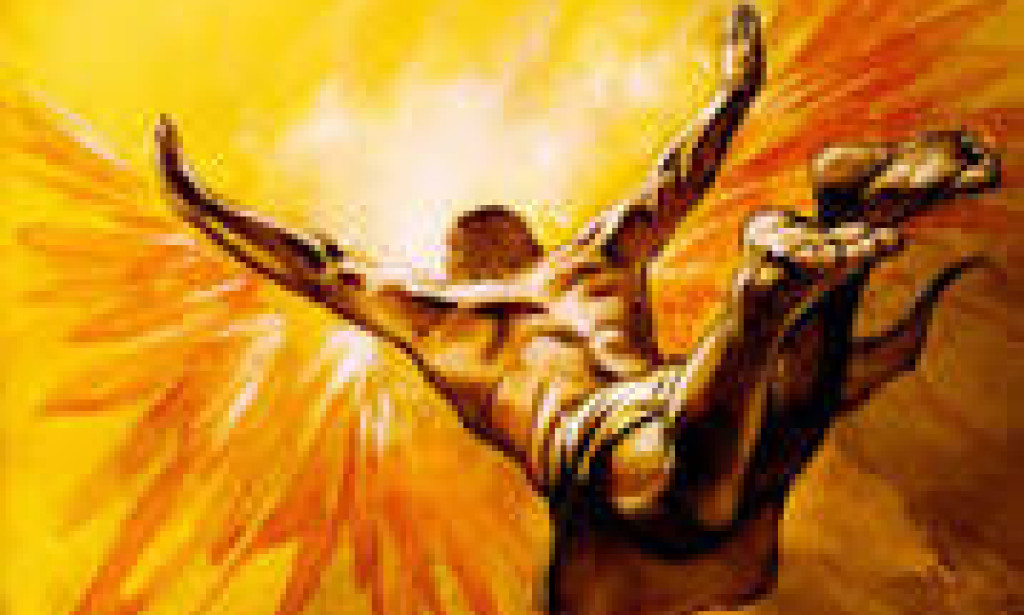
Eventually, he flew so close to the sun that the heat began to melt the wax holding his wings together. The feathers came loose, and Icarus began to fall.
Daedalus could not save his son.
Icarus fell into the sea and drowned. The place where he fell was later associated with him and became known in Greek tradition as the Icarian Sea.
Daedalus eventually reached safety, but his son's death became the tragic conclusion of their escape.
The Meaning of the Myth
The story of Icarus can be interpreted in several ways. One of its most important lessons concerns the dangers of ignoring good advice.
Daedalus was not trying to prevent Icarus from enjoying his freedom. Instead, he was trying to protect him. He understood the limitations of their wings and knew that flying too high could be fatal.
Icarus ignored this advice because he became overwhelmed by excitement and ambition. His tragedy was not caused simply by wanting to fly. Rather, it was caused by failing to recognize the limits of what he could safely do.
This makes the myth relevant to everyday life. People are often encouraged to dream big and pursue their goals. Ambition can be positive because it motivates people to work hard and accomplish difficult things. However, ambition without caution can lead to serious consequences.
The myth therefore suggests that success requires not only courage and ambition but also wisdom and self-control.
Ambition and Human Nature
One reason the story of Icarus has remained popular is that it reflects a basic part of human nature. People often want more than what they already have.
A person who achieves one goal may immediately begin pursuing another. Someone who becomes successful may want greater success. A student who receives a good grade may want an even higher grade. An athlete who wins a competition may want to break another record.
Ambition can lead to extraordinary achievements. Many scientific discoveries, inventions, artistic works, and social improvements have resulted from people refusing to accept limitations.
However, ambition can also become dangerous when people stop considering consequences.
Icarus represents this kind of uncontrolled ambition. He had been given an opportunity to escape, but instead of remaining within safe limits, he pushed beyond them.
The myth does not necessarily suggest that people should avoid ambition. Instead, it encourages people to balance ambition with judgment.
The Symbolism of the Wings
The wings in the story have a powerful symbolic meaning. They represent freedom, imagination, human creativity, and the desire to overcome limitations.
Before the invention of the wings, Daedalus and Icarus were trapped. They could not simply walk or sail away safely. The wings gave them a new possibility.
In this sense, the wings represent human innovation. Daedalus used intelligence and creativity to solve a problem that seemed impossible. His invention allowed humans to do something that normally belonged only to birds.
However, the wings also represent the dangers of new power. Having the ability to do something does not necessarily mean that a person should do it without caution.
Modern technology provides many examples of this idea. Humans have developed airplanes, nuclear energy, artificial intelligence, genetic engineering, and other powerful technologies. These inventions can benefit society, but they can also create risks if they are used irresponsibly.
The wings of Icarus can therefore be viewed as a symbol of both human achievement and human vulnerability.
Daedalus as a Father
Another important aspect of the myth is the relationship between Daedalus and Icarus.
Daedalus is portrayed as intelligent and experienced. He understands the dangers of the journey and gives his son clear instructions. His warning shows that he cares deeply about Icarus.
However, the story also raises questions about parental responsibility. Daedalus creates the wings that ultimately become the means of Icarus's death. Although he warns his son, he cannot completely control his son's actions.
This reflects a difficult reality of parenting. Parents can provide guidance, education, protection, and warnings, but they cannot make every decision for their children. As children grow older, they eventually have to make choices for themselves.
The tragedy of Icarus demonstrates how painful the consequences can be when a child ignores valuable guidance.
The Role of Disobedience
Disobedience is another major theme in the story.
Icarus was given very specific instructions. His father did not tell him that he could not fly. Instead, Daedalus gave him limits within which he could fly safely.
Icarus's decision to ignore these limits led directly to his downfall.
In many cultures, stories teach children to listen to their elders because older people often possess knowledge gained through experience. This does not mean that every instruction should be followed blindly. Rather, the myth highlights the importance of understanding why wise advice is given.
Icarus did not fully appreciate the danger until it was too late.
The story therefore reminds us that freedom and responsibility are connected. Having freedom means being responsible for the consequences of our choices.
The Myth in Modern Society
Although the story originated in ancient Greece, it continues to influence modern literature, art, music, education, and popular culture.
The phrase "flying too close to the sun" is often used as a metaphor for someone who becomes too ambitious or takes excessive risks. It can describe a person who achieves great success but then becomes overconfident and makes a decision that causes failure.
The myth can also be applied to business. An entrepreneur may develop a successful company but expand too quickly and create financial problems. A professional may become successful and then take unnecessary risks because of overconfidence.
In education, students can also relate to the story. Ambition is valuable, but students must recognize their limits and develop their abilities gradually. Trying to achieve everything immediately can result in stress, disappointment, or failure.
The myth is also relevant to technology. Humanity's ability to create increasingly powerful technologies brings both opportunities and responsibilities. Innovation must be accompanied by careful consideration of consequences.
Different Interpretations
There is no single interpretation of the myth of Icarus. Different readers can find different lessons in the story.
One interpretation sees Icarus as a symbol of foolishness. He ignores his father's warning and suffers the consequences.
Another interpretation views Icarus as a symbol of youthful curiosity. His desire to explore the sky represents the human desire to discover new possibilities.
A third interpretation focuses on freedom. Icarus experiences a brief moment of extraordinary freedom before his actions lead to tragedy.
The story can also be interpreted as a warning against excessive pride. Icarus may have become so impressed by his ability to fly that he forgot that the wings were fragile.
These interpretations demonstrate why myths remain valuable. They are not simply stories with one fixed meaning. They can be examined from different perspectives and applied to different circumstances.
Lessons We Can Learn from Icarus
The myth provides several important lessons.
First, ambition should be balanced with wisdom. It is good to have goals, but people must understand the risks associated with pursuing them.
Second, good advice should not be ignored carelessly. People with greater experience can often identify dangers that younger or less experienced individuals may not recognize.
Third, freedom comes with responsibility. Icarus was free to fly, but he was also responsible for controlling how he used that freedom.
Fourth, overconfidence can be dangerous. Success can sometimes cause people to believe that they are capable of more than they actually are.
Finally, failure can result from a lack of self-control. Icarus's problem was not simply that he dreamed of flying. His problem was that he failed to control his behavior despite knowing the risks.
Conclusion
The myth of Icarus is one of the most memorable stories from ancient Greek mythology. It tells the tragic story of a young man who escapes imprisonment with his father using wings made from feathers and wax. Despite his father's warning not to fly too high, Icarus becomes excited by the experience and rises toward the sun. The heat melts the wax, his wings fall apart, and he plunges into the sea.
At its deepest level, the story is about more than flying. It is about human nature. People naturally want freedom, achievement, discovery, and success. These desires can lead to remarkable accomplishments, but they can also become dangerous when combined with recklessness or excessive confidence.
The story of Icarus reminds us that ambition is most valuable when it is guided by wisdom. Dreams encourage people to reach beyond what seems possible, but good judgment helps them understand how far they can safely go. Icarus's tragedy therefore continues to provide an important lesson: we should pursue our dreams boldly, but we must also recognize limits, listen to wisdom, and take responsibility for our choices.
Thousands of years after the story was first told, the image of Icarus falling from the sky remains powerful. His story continues to remind humanity that the desire to rise can be inspiring, but without wisdom and self-control, the same desire can lead to a fall.

You must be logged in to post a comment.