

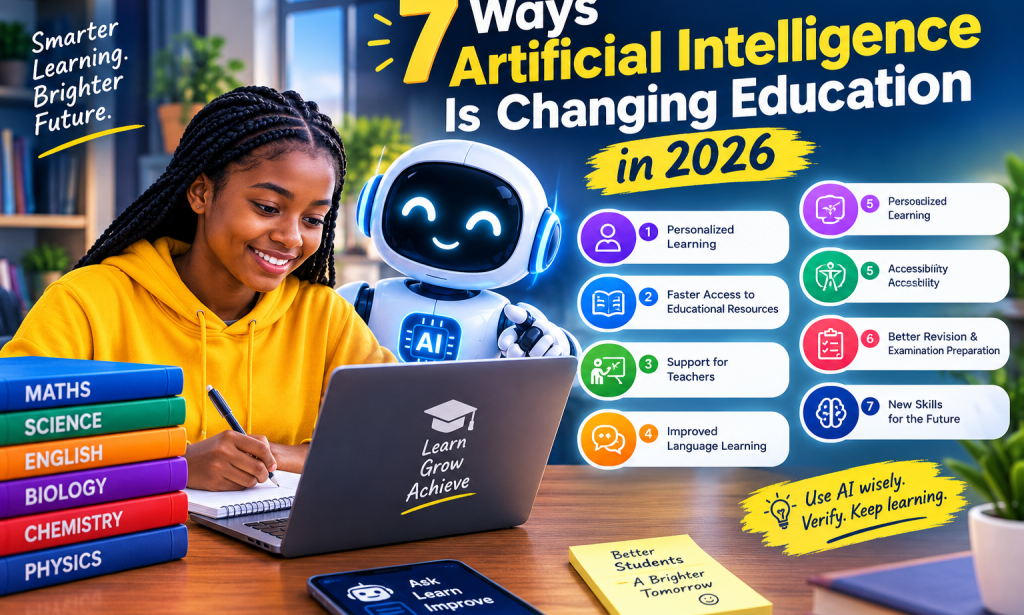
7 Ways Artificial Intelligence Is Changing Education in 2026
Summary
Artificial intelligence is transforming education by helping students learn more effectively, supporting teachers, and making educational resources more accessible. Discover seven important ways AI is changing classrooms, personal study, and the future of learning in 2026.
Introduction
Education is changing rapidly as technology becomes an increasingly important part of everyday life. From online classrooms to digital libraries, students now have more opportunities to access information than ever before.
One of the most significant developments is artificial intelligence (AI). AI-powered tools can explain difficult concepts, provide practice questions, assist with language learning, and help teachers organize educational materials.
Although AI offers many benefits, it also creates challenges involving accuracy, privacy, and excessive dependence on technology. Understanding how to use these tools responsibly can help students and teachers benefit from them.
Here are seven ways artificial intelligence is changing education in 2026.
1. Personalized Learning
Every student learns differently. Some understand a topic quickly, while others need additional explanations and practice.
AI-powered learning tools can adapt explanations, suggest exercises, and provide feedback based on a learner's responses. For example, a student struggling with physics can request a simpler explanation before attempting more difficult problems.
This can make learning more flexible and help students identify areas that need improvement.
However, AI-generated explanations should be checked against textbooks, teachers' guidance, and reliable educational materials.
2. Faster Access to Educational Resources
Students no longer have to depend exclusively on physical textbooks or classroom notes to find learning materials.
Digital AI assistants can help explain concepts, summarize notes, generate revision questions, and organize study schedules.
A student preparing for an examination can use these tools to create a revision timetable and practise questions on challenging topics.
AI does not replace the need to study official syllabuses or practise genuine examination questions. Instead, it can make those activities easier to organize.
3. Support for Teachers
Teachers often spend considerable time preparing lessons, creating exercises, and marking certain types of assignments.
AI tools can assist with drafting lesson plans, generating examples, preparing quizzes, and adapting explanations for different learning levels.
This may allow teachers to devote more time to classroom interaction and individual student support.
Nevertheless, teachers must review AI-generated materials to ensure that they are correct, appropriate, and consistent with their curriculum.
4. Improved Language Learning
Learning a new language requires regular practice in reading, writing, listening, and speaking.
AI-powered tools can help learners understand unfamiliar vocabulary, practise conversations, correct grammar, and receive explanations of common mistakes.
For example, a student improving their English can ask an AI assistant to explain the difference between nouns, verbs, adjectives, and adverbs.
These tools can offer convenient practice outside school hours, although human interaction remains valuable for developing communication skills.
5. Greater Accessibility
Technology can make educational resources easier to access for some learners with disabilities or different learning needs.
Depending on the available tools, AI can support speech-to-text conversion, text-to-speech reading, image descriptions, translation, and simplified explanations.
These capabilities can help more learners participate in educational activities.
However, accessibility tools do not work equally well for everyone. Students should use options that suit their needs and seek additional support when necessary.
6. Better Revision and Examination Preparation
Examination preparation involves more than reading notes repeatedly. Students need to practise retrieving information, identify weaknesses, and review difficult topics.
AI can help generate flashcards, quizzes, practice questions, and explanations of incorrect answers.
For example, a student preparing for JAMB can ask for practice questions on a specific Biology topic and use the explanations to understand mistakes.
Students should distinguish AI-generated practice questions from official past questions. They should also verify answers and follow the current examination syllabus.
The goal is to develop understanding and independent problem-solving skills rather than memorize answers without knowing why they are correct.
7. New Skills for the Future
As AI becomes more common in different industries, students need to develop skills that help them work effectively with technology.
These include critical thinking, creativity, communication, digital literacy, and responsible information use.
Students should learn how to write clear instructions for AI tools, evaluate the information they receive, and recognize when an answer may be inaccurate.
Understanding the limitations of AI is just as important as knowing how to use it.
Challenges of Using AI in Education
Despite its advantages, artificial intelligence has limitations.
First, AI can generate incorrect information. Students who accept every answer without checking it may learn the wrong concepts.
Second, excessive dependence on AI can weaken independent learning if students use it to complete every task without thinking.
Third, internet access, device availability, and subscription costs can prevent some learners from benefiting equally.
Privacy is another concern. Students should avoid sharing passwords, private school records, or other sensitive information with AI tools.
Schools and families can help by encouraging responsible use, verifying information, and ensuring that students continue to practise their own skills.
Conclusion
Artificial intelligence is creating new opportunities in education by supporting personalized learning, improving access to resources, assisting teachers, and helping students prepare for examinations.
However, technology is most useful when combined with reliable learning materials, effective teaching, and personal effort.
Students should use AI to ask better questions, understand difficult subjects, and practise their skills—not as a shortcut that eliminates learning.
The future of education will depend not only on the technology available but also on how responsibly people use it.
Final insight: Learn to use artificial intelligence wisely, verify what it tells you, and keep developing the knowledge and skills that make you an independent learner.


You must be logged in to post a comment.