

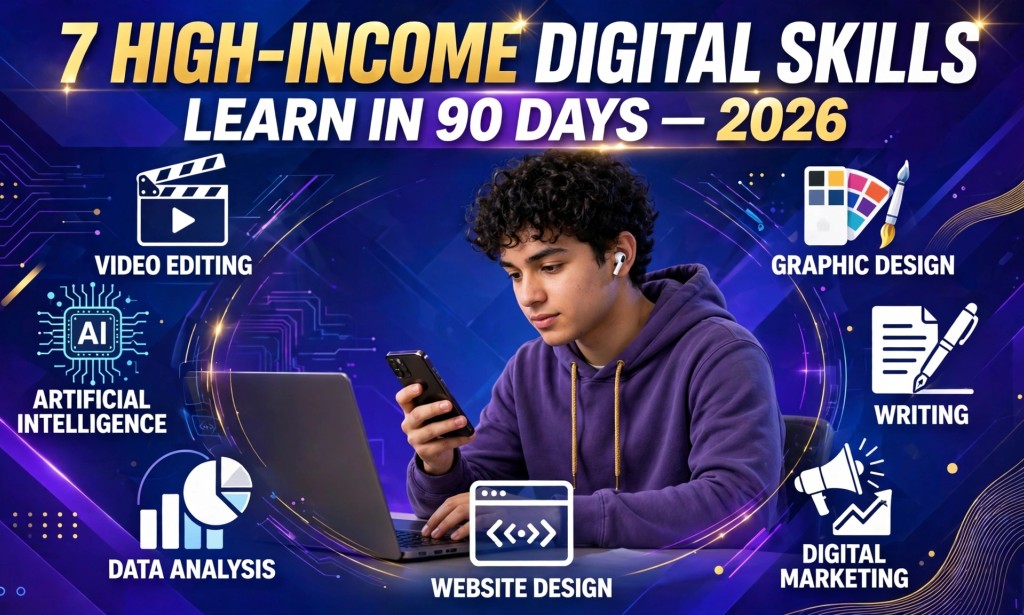
7 High-Income Digital Skills You Can Self-Learn In Under 90 Days In 2026
The internet has created new opportunities for people who want to develop practical skills, work with businesses, and explore different career paths. Today, you do not always need an expensive degree or classroom training to begin learning something valuable. With a smartphone or computer, an internet connection, and consistent practice, you can start developing digital skills from home.
However, not every skill produces income quickly, and watching tutorials alone will not make you an expert. The real advantage comes from learning how to solve problems that people and businesses are willing to pay someone to solve.
In 2026, skills involving digital content, marketing, design, data, and technology offer several possible starting points. The World Bank's research on digital skills in Africa identifies areas such as digital marketing, content creation, data analysis, and software development among the digital skills relevant to employment.
Here are seven digital skills you can begin learning independently within 90 days.
1. Video Editing
Video editing is a valuable skill for people who enjoy creating engaging visual content. Businesses, YouTubers, educators, and social media creators use videos to explain ideas, promote products, tell stories, and connect with audiences.
Your job as an editor is to transform raw footage into a polished video. This can involve cutting unnecessary scenes, adding subtitles, adjusting audio, choosing suitable transitions, and organising clips into an interesting sequence.
You can start learning with mobile editing applications such as CapCut or explore computer-based editing software as your abilities improve.
Your 90-day learning plan:
- Days 1–30: Learn basic cuts, transitions, subtitles, audio adjustments, and video formatting.
- Days 31–60: Practise editing short videos, promotional clips, and storytelling content.
- Days 61–90: Create a portfolio containing several original editing projects.
Once you have developed reliable skills, you can explore opportunities to edit videos for content creators, local businesses, or other clients.
Your success will depend on the quality of your work, your ability to meet deadlines, and your understanding of what makes videos engaging.
2. Graphic Design
Graphic design involves communicating ideas through images, typography, colours, and layouts.
Businesses need designs for social media posts, event posters, advertisements, product promotions, presentations, and brand identities. This creates opportunities for people who can produce attractive, readable, and purposeful designs.
Beginners can explore tools such as Canva before progressing to more advanced design software.
Your 90-day learning plan:
- Days 1–30: Study colour combinations, typography, spacing, alignment, and composition.
- Days 31–60: Design sample flyers, promotional graphics, social media posts, and presentation slides.
- Days 61–90: Build a portfolio showing different design styles and explain the purpose of each project.
Do not focus exclusively on making designs look beautiful. Learn to make information easy to understand and ensure that every design suits its intended audience.
For example, a restaurant promotion should make the offer, product, and contact details clear. A school event poster needs a different layout and tone.
The ability to understand these differences can make your services more useful to potential clients.
3. Copywriting and Content Writing
If you enjoy writing, copywriting and content writing may be suitable options.
Content writing involves creating informative material, such as blog articles, educational guides, website content, and newsletters. Copywriting focuses more directly on persuasive communication, including advertisements, product descriptions, landing pages, and promotional messages.
Both skills require clear communication, research, grammar, and an understanding of the intended audience.
You can practise by writing sample articles, improving product descriptions, and creating fictional advertising campaigns. AI tools can help you brainstorm ideas and review drafts, but you should develop your own judgement and verify factual claims.
Your 90-day learning plan:
- Days 1–30: Practise writing headlines, introductions, summaries, and clear paragraphs.
- Days 31–60: Create sample blog articles, product descriptions, email messages, and advertisements.
- Days 61–90: Assemble your strongest writing samples into an organised portfolio.
Potential opportunities include writing for websites, helping businesses communicate their offers, and creating content for digital publications.
The important thing is to demonstrate that you can produce original, useful writing rather than simply generate large amounts of text.
4. Digital Marketing
Digital marketing helps businesses reach customers through online channels.
It includes activities such as social media marketing, search engine optimisation, email marketing, content promotion, and online advertising.
For example, a small clothing business might need help planning Instagram posts, improving its product descriptions, attracting visitors to its website, or understanding which content receives the most attention.
You do not need to learn every part of digital marketing immediately. Starting with one area can make the learning process more manageable.
Your 90-day learning plan:
- Days 1–30: Learn marketing fundamentals, audience research, content planning, and basic search engine optimisation.
- Days 31–60: Develop a sample marketing campaign for a fictional business.
- Days 61–90: Create a content calendar, propose campaign ideas, and practise measuring engagement.
You can study educational materials from Google's learning resources and other reputable training providers.
Remember that successful marketing involves more than posting frequently. You must understand the audience, communicate a clear message, and evaluate whether your work is helping achieve the intended goal.
With experience, you may explore opportunities to support small businesses, creators, or organisations with their online marketing activities.
5. Website Design
Website design combines visual presentation, organisation, usability, and sometimes programming.
Businesses use websites to explain their services, display products, publish information, and communicate with customers. Learning to create attractive, easy-to-navigate websites can therefore be a useful professional skill.
Beginners can explore website builders such as WordPress and other no-code tools. Those interested in programming can gradually learn HTML, CSS, and JavaScript.
Your 90-day learning plan:
- Days 1–30: Study website layouts, navigation, typography, mobile responsiveness, and basic design principles.
- Days 31–60: Build practice websites for fictional businesses, such as a restaurant, clothing store, or photography service.
- Days 61–90: Improve the websites, test them on mobile devices, and organise screenshots or live demonstrations into a portfolio.
A strong beginner project should be easy to navigate, readable on different screen sizes, and clear about the business it represents.
You do not have to build a complicated application to demonstrate your abilities. A well-designed, functional website can be an excellent starting project.
6. Data Analysis
Data analysis involves examining information to identify patterns, answer questions, and support better decisions.
Businesses collect information about sales, customers, expenses, website visits, and many other activities. Analysing this information can help them understand what is working and where improvements may be needed.
Beginners can start with Microsoft Excel or Google Sheets before progressing to tools such as SQL and Power BI.
Your 90-day learning plan:
- Days 1–30: Learn spreadsheets, formulas, sorting, filtering, and basic charts.
- Days 31–60: Practise cleaning and analysing sample datasets.
- Days 61–90: Create a dashboard or report explaining the results of a small analysis project.
For example, you could analyse a fictional shop's monthly sales and identify its best-selling products.
Your final report should explain what the data shows instead of simply presenting numbers and charts.
Data analysis can require more practice than some creative skills, particularly when learning databases and statistical concepts. Nevertheless, building a solid foundation can help you progress towards more advanced opportunities.
7. AI-Assisted Productivity and Automation
Artificial intelligence is becoming an increasingly useful tool for writing, research, organisation, and repetitive digital tasks.
Learning to use AI effectively means understanding how to give clear instructions, evaluate generated information, improve results, and combine tools to complete useful tasks.
Automation goes a step further by connecting processes so that certain repetitive actions can happen with less manual work.
For example, a business might want to organise customer enquiries, sort information into spreadsheets, or create a repeatable content-planning workflow.
Your 90-day learning plan:
- Days 1–30: Learn how to write clear prompts, verify AI-generated information, and use AI for brainstorming and summarisation.
- Days 31–60: Create practical workflows for research, content planning, document organisation, or spreadsheet tasks.
- Days 61–90: Develop demonstrations showing how your workflows save time or make tasks easier.
Do not assume that using AI automatically makes you an automation specialist. Reliable automation also requires logical thinking, testing, troubleshooting, and understanding the process you want to improve.
As your skills develop, you can explore ways to help individuals and businesses use digital tools more efficiently.
How to Make the Most of Your First 90 Days
The biggest mistake beginners make is trying to learn too many skills simultaneously.
Choose one primary skill based on your interests, available equipment, and the type of work you would enjoy doing.
Set aside a realistic amount of practice time each week. Follow structured lessons, but spend just as much time creating your own projects.
By the end of the first month, you should understand the fundamentals. During the second month, concentrate on practical projects. In the final month, refine your work and organise your best examples into a portfolio.
A portfolio gives potential clients or employers something concrete to evaluate. It can contain writing samples, edited videos, design projects, websites, data dashboards, or demonstrations of useful automated workflows.
You can then begin exploring appropriate internships, entry-level opportunities, or small projects that match your abilities.
Keep your expectations realistic: 90 days can be enough to establish a foundation and produce beginner-level work, but it does not guarantee a job or high income. Earnings depend on your competence, the demand for your service, competition, communication, and your ability to find suitable opportunities.
Final Thoughts
Learning a digital skill can be a practical way to invest in your future. Video editing, graphic design, copywriting, digital marketing, website design, data analysis, and AI-assisted productivity each offer different learning experiences and possible career paths.
You do not need to master all seven. Choose one, practise consistently, build useful projects, and improve through feedback.
Which of these seven digital skills would you choose to learn first, and why?
If you found this article helpful, please like it, leave a comment, share it with someone who wants to develop digital skills, and follow my profile for more educational and career-focused articles. You can also donate to support my writing and help me publish more useful content.
Disclaimer: Income opportunities vary, and no particular earning level or employment outcome is guaranteed.


You must be logged in to post a comment.