

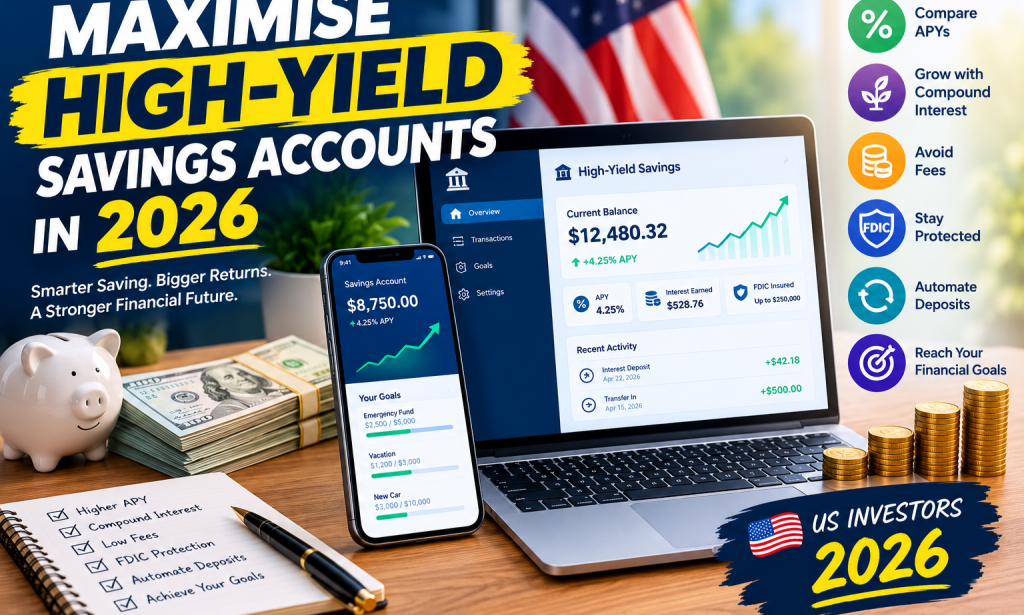
How To Maximise High Yield Savings Accounts For US Investors In 2026
Saving money is an important part of building a secure financial future, but keeping your money in an account that pays little interest can limit its growth. For US investors who want to earn more from their savings without exposing that money to stock market fluctuations, a high-yield savings account can be a useful option.
High-yield savings accounts offer interest rates that can be significantly higher than those of traditional savings accounts. They allow account holders to earn interest while keeping their money relatively accessible for emergencies, planned purchases, and other short-term financial goals.
However, opening an account is only the beginning. Knowing how to choose the right account, make regular deposits, and take advantage of compound interest can help you get more value from your savings.
Here are seven practical ways to maximise high-yield savings accounts in 2026.
1. Compare Interest Rates Before Opening an Account
One of the most important steps is comparing annual percentage yields, commonly known as APYs.
APY measures the total interest an account can earn over a year, taking compounding into consideration. Generally, a higher APY means your savings can grow faster, provided the rate remains unchanged and other conditions are equal.
For example, imagine you deposit $10,000 into a high-yield savings account offering a 4% APY. If the rate remains constant for one year and you make no additional deposits or withdrawals, you could earn approximately $400 in interest.
A traditional savings account offering a much lower rate could generate considerably less interest on the same balance.
Nevertheless, do not choose an account based on its advertised rate alone. Some banks offer promotional rates that last for a limited period, while others require customers to maintain a minimum balance or meet specific conditions.
Compare several accounts and check their current APYs, fees, minimum deposit requirements, and eligibility rules before making your decision.
You can review current comparisons from financial publications such as .
2. Take Advantage of Compound Interest
Compound interest is one of the biggest advantages of maintaining a savings account over time.
It allows you to earn interest on your original deposit and, as interest accumulates, potentially earn interest on previous interest as well.
Consider an account with an initial deposit of $5,000 and an APY of 4%. Assuming the rate remains constant and interest stays in the account, the balance could grow to approximately $5,200 after one year.
If you leave the money untouched, the following year's interest can be calculated on the larger balance rather than only the original $5,000.
The effect becomes more noticeable over longer periods, especially when you continue adding money.
To benefit from compounding, avoid withdrawing earned interest unnecessarily. Allowing your balance to grow gives your savings more opportunity to generate additional returns.
Remember that these examples are estimates. Actual earnings depend on the account's rate, compounding method, deposits, withdrawals, fees, and applicable terms.
3. Make Regular Deposits to Grow Your Balance
Your interest rate matters, but the amount you save also plays a major role in determining how much interest you earn.
A high APY cannot generate substantial returns from a very small balance immediately. Consistent contributions can help you build that balance over time.
For example, suppose you begin with $1,000 and contribute another $100 every month. Your savings will grow through your deposits, with interest providing additional growth.
You do not necessarily need to make large contributions. The key is establishing a realistic amount that fits your income and expenses.
Consider setting a monthly savings target and increasing it when your financial circumstances improve.
You can also divide your savings goal into smaller milestones. Instead of concentrating only on reaching $10,000, aim to save your first $500, then $1,000, and gradually work towards your larger target.
These milestones make progress easier to track and can encourage you to maintain the habit.
Most importantly, avoid committing money you need for essential expenses. A sustainable savings plan is more useful than an ambitious target that becomes difficult to maintain.
4. Avoid Fees That Reduce Your Earnings
Fees can quietly reduce the benefits of a high-yield savings account.
Although many online savings accounts advertise no monthly maintenance fees, requirements differ between financial institutions.
Some accounts may impose charges for certain services or require particular conditions to receive the advertised benefits.
Before opening an account, examine the fee schedule carefully.
Pay attention to monthly maintenance charges, minimum balance requirements, and any other fees that could affect your earnings.
For instance, if your savings generate $100 in interest over a particular period but account charges consume $30, you retain less of the benefit.
Choosing an account with a competitive APY and minimal fees can therefore be more valuable than selecting one with an attractive headline rate but expensive conditions.
Also, check whether the account requires you to open another product or maintain a linked checking account to qualify for its highest advertised rate.
Read the account disclosures before agreeing to the terms. The can help consumers understand deposit protection and related banking considerations.
5. Choose an Account With Appropriate Deposit Protection
Earning interest is important, but protecting your savings should remain a priority.
For US investors, checking whether a bank is insured by the Federal Deposit Insurance Corporation (FDIC) is an essential step.
FDIC insurance generally protects eligible deposits up to $250,000 per depositor, per insured bank, per ownership category if an insured bank fails.
Covered deposit products include eligible savings accounts, checking accounts, and certain other bank deposits.
However, FDIC insurance does not cover every financial product. Stocks, bonds, mutual funds, and cryptocurrency are examples of assets that are not insured by the FDIC.
This distinction matters because a savings account is designed to hold deposits, while investments such as stocks can fluctuate in value.
If your total deposits exceed the applicable insurance limit at one bank, consider reviewing how your accounts are structured and whether additional coverage arrangements may be appropriate.
Do not assume that opening multiple accounts at the same bank automatically increases your coverage. Deposits in the same ownership category are generally combined when calculating the limit.
You can verify a bank's insurance status and learn more about coverage through the official .
6. Automate Your Savings Contributions
Automating deposits can make saving easier and more consistent.
Instead of relying entirely on motivation, you can schedule recurring transfers from your checking account to your high-yield savings account.
For example, you might arrange for $50 or $100 to move into savings every payday, provided the amount fits your budget.
This approach helps turn saving into a regular financial habit rather than something you do only when money is left over.
Automation can also reduce the temptation to spend money that you intended to save.
However, ensure that your checking account has enough money to cover scheduled transfers and essential bills. Poorly timed transfers can contribute to overdrafts or other unnecessary charges, depending on your account terms.
Review your automatic contributions whenever your income or expenses change.
If you receive a bonus, tax refund, or other unexpected income, you might choose to direct a portion towards your savings goal after accounting for immediate needs.
Small, consistent contributions can make a meaningful difference over time.
7. Review Your APY and Savings Goals Regularly
A high-yield savings account is not necessarily a set-it-and-forget-it financial product.
Many savings accounts have variable interest rates, meaning their APYs can change as market conditions and bank policies change.
An account that offers a competitive rate today may offer a lower rate several months later.
Make a habit of reviewing your account periodically. Compare its current APY with other available accounts and check whether any promotional offers have expired.
However, avoid switching accounts simply because another bank advertises a slightly higher rate. Consider the complete picture, including fees, access to your money, customer service, eligibility requirements, and deposit protection.
You should also review your savings goals.
Money intended for emergencies may need to remain accessible, while funds earmarked for a future purchase might follow a different savings schedule.
Keep enough money available for expected expenses and emergencies before directing additional funds towards longer-term investments.
High-yield savings accounts can complement an investment strategy, but they do not replace every other financial tool. Your choice should reflect your individual goals, financial circumstances, and comfort with risk.
Final Thoughts
Maximising a high-yield savings account in 2026 requires more than finding an attractive interest rate. It involves comparing APYs, taking advantage of compound interest, making consistent deposits, avoiding unnecessary fees, and understanding deposit insurance.
Regularly reviewing your account can also help you identify opportunities to improve your savings strategy as rates and personal circumstances change.
Remember that interest rates are not guaranteed to remain constant, and interest earned may have tax implications under US tax rules.
Start by identifying your savings goal, choosing an account that suits your needs, and establishing a realistic contribution schedule. Over time, consistent habits can help you build a stronger financial foundation.
What do you think is the most important factor when choosing a high-yield savings account: the interest rate, low fees, or easy access to your money?
If you found this article helpful, please like it, leave a comment, share it with someone who could benefit, and follow my profile for more finance and business articles. You can also donate to support my writing and help me create more useful content.
Disclaimer: This article is for educational purposes only and should not be considered personalised financial or tax advice.


You must be logged in to post a comment.