
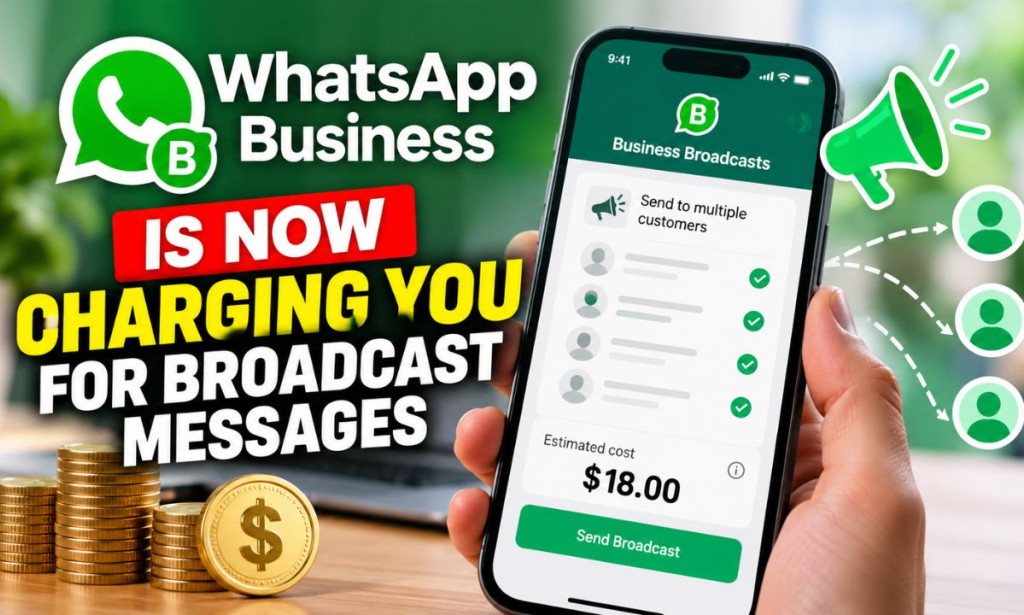
WhatsApp Business is changing the economics of marketing through the world's most popular messaging app. Businesses that have become accustomed to sending promotions, offers, announcements and customer updates through WhatsApp now need to pay much closer attention to how many people they contact and, more importantly, which customers actually receive their campaigns.
Meta has introduced Business Broadcasts, a more advanced form of mass business messaging inside the WhatsApp Business app. Unlike ordinary conversations, Business Broadcasts are a paid feature in supported markets.
That does not mean WhatsApp is charging ordinary users to send messages, nor does it mean that every conversation between a company and a customer suddenly has a fee.
The change specifically affects business-oriented broadcast functionality designed to let companies communicate with multiple customers at scale.
For marketers, ecommerce stores, restaurants, agencies, clinics, real estate companies and other businesses that use WhatsApp as a customer acquisition and retention channel, this is an important change.
It effectively transforms WhatsApp broadcasts from something many businesses treated as a free promotional channel into a measurable marketing expense.
What Are WhatsApp Business Broadcasts?
Business Broadcasts are designed to help companies send messages to multiple existing contacts from the WhatsApp Business app.
Instead of manually contacting customers one by one, a business can prepare a message and distribute it across an audience.
Businesses can use broadcasts for promotions, product announcements, discounts, new inventory, appointment reminders, events, customer reactivation campaigns and other communications.
WhatsApp describes the feature as particularly useful for keeping existing customers engaged through offers, discounts and promotions, while also supporting announcements, new-item updates, thank-you messages and requests for feedback.
This makes Business Broadcasts much closer to an email-marketing or SMS-marketing campaign than a traditional WhatsApp conversation.
The major difference is where the message appears.
Instead of arriving in an email inbox or traditional SMS application, it arrives directly inside WhatsApp, where users are already communicating throughout the day.
That access can be extremely valuable for businesses.
It is also one of the reasons Meta is putting more controls around commercial messaging.
Is WhatsApp Business Really Charging for Broadcast Messages?
Yes.
Meta has officially described Business Broadcasts as a paid feature.
When announcing changes to business messaging, Meta explained that WhatsApp was developing a more advanced message type called Business Broadcasts and making the feature paid so businesses would be more thoughtful about what they send.
WhatsApp's current Help Center is even more explicit.
Businesses can send Business Broadcasts for a fee, and charges are based on messages successfully delivered to recipients within the applicable delivery period.
This means WhatsApp is moving toward an environment where sending thousands of marketing messages without considering relevance can carry a real financial cost.
That has major implications for WhatsApp marketing strategy.
WhatsApp Is Not Charging for Every Message You Send
This distinction is extremely important.
The introduction of paid Business Broadcasts does not mean you will have to pay every time you respond to a customer inside the WhatsApp Business app.
It also does not mean personal WhatsApp users are suddenly being charged to chat with friends or family.
Business Broadcasts are a specific commercial messaging feature.
Meta has separately emphasized that personal WhatsApp chats remain private and end-to-end encrypted as it expands its broader business monetization strategy across WhatsApp.
The change should therefore be understood as the monetization of certain business messaging capabilities rather than the conversion of WhatsApp itself into a pay-per-message consumer service.
How WhatsApp Business Broadcast Pricing Works
WhatsApp's pricing system is more complicated than a single worldwide rate.
According to WhatsApp, the price of a Business Broadcast is determined by the country code of the message recipient.
WhatsApp currently maintains rate cards across multiple currencies, including USD, EUR, GBP, BRL, MXN, COP, INR and others. Additional currencies can be supported through USD-based conversions.
This means there is no responsible way to say:
“Every WhatsApp broadcast message costs $0.05.”
A business sending campaigns to customers in the United States could have different economics from a company targeting customers in India, Brazil, Colombia or another country.
WhatsApp displays the estimated total, taxes where applicable and overall estimated campaign cost before checkout.
That estimate gives businesses an opportunity to determine whether a campaign makes financial sense before sending it.
You Pay for Successfully Delivered Broadcast Messages
One of the most important details is that WhatsApp's Business Broadcast billing model is tied to delivery.
WhatsApp states that businesses pay for each message delivered to a contact within five days after the broadcast is sent.
Suppose you select 2,000 customers for a campaign.
If WhatsApp initially calculates the potential cost based on those 2,000 recipients but some messages cannot be delivered, the final amount can be lower.
WhatsApp explains that funds associated with broadcasts that cannot be successfully delivered can be credited back to the business's account for future use.
This makes delivered messages a fundamental metric for businesses.
But delivery is only the beginning.
A good marketing strategy also needs to measure how many customers read, reply, click, purchase or book after receiving the campaign.
A Simple Formula for Calculating WhatsApp Broadcast Cost
The basic calculation is:
Broadcast Cost = Successfully Delivered Messages × Applicable Message Rate
Imagine your WhatsApp Business account shows an applicable hypothetical rate of $0.04 for a particular audience.
You send a campaign to 4,000 customers.
Suppose 3,800 messages are successfully delivered.
The calculation would be:
3,800 × $0.04 = $152
The $0.04 number here is only an example and should not be interpreted as WhatsApp's universal rate.
Your actual cost depends on the pricing displayed by WhatsApp for your recipient market and account.
Once you know your broadcast cost, the more useful calculation becomes return on investment.
WhatsApp Broadcast ROI = (Campaign Profit − Broadcast Cost) ÷ Broadcast Cost × 100
That equation tells you whether your WhatsApp marketing campaigns are actually generating enough profit to justify what you spend.
Why Is WhatsApp Charging Businesses for Broadcasts?
The decision is not simply about generating additional revenue.
WhatsApp also faces an important product problem.
If millions of businesses can send unlimited promotional messages at almost no cost, users' inboxes can quickly become overloaded with advertisements.
That could damage one of WhatsApp's greatest assets: users perceive their messaging inbox as a relatively personal communication environment.
Meta says paid Business Broadcasts are intended to encourage businesses to be more thoughtful about the messages they send.
WhatsApp has also introduced limits on how many marketing messages people can receive and provides users with feedback mechanisms that allow them to indicate whether they are interested in certain business communications.
From a marketing perspective, this changes the incentive.
Sending irrelevant messages is no longer simply annoying.
It can also become expensive.
The Biggest Change: Audience Quality Matters More Than Audience Size
For years, many businesses approached WhatsApp marketing using a simple strategy:
Get as many phone numbers as possible and send promotions to everyone.
Paid Business Broadcasts weaken that strategy.
Imagine an ecommerce business with 20,000 WhatsApp contacts.
The company launches a promotion for women's running shoes.
It has two options.
The first is sending the campaign to all 20,000 contacts.
The second is identifying 2,400 customers who previously purchased running products, viewed sportswear, asked about running shoes or interacted with related promotions.
Even if the smaller campaign produces fewer total impressions, it may generate a significantly higher conversion rate while dramatically reducing messaging costs.
This is where customer segmentation becomes critical.
Businesses that understand their audience can potentially generate more revenue while sending fewer messages.
A Realistic Example: Local Dental Clinic
Consider a dental clinic with 5,000 customer contacts inside its CRM.
The clinic wants to promote professional teeth whitening.
A basic strategy would send:
“Get 20% off professional teeth whitening this week. Book your appointment today.”
to all 5,000 contacts.
That could generate bookings, but it could also waste money contacting patients who have no interest in cosmetic dentistry.
A smarter approach would analyze customer data.
Perhaps the clinic identifies 680 patients who previously asked about whitening, veneers, smile design or cosmetic dentistry.
The campaign is sent only to those patients.
If the campaign costs $35 and generates five treatments producing $600 in attributable profit, the return would be:
($600 − $35) ÷ $35 × 100 = 1,614% ROI
These numbers are hypothetical, but they demonstrate the principle.
The goal is no longer maximizing the number of messages sent.
The goal is maximizing the economic value of every delivered message.
Business Broadcasts Include Campaign Analytics
Another important difference between Business Broadcasts and basic messaging is measurement.
WhatsApp provides businesses with broadcast insights.
Businesses can review information including how many times a broadcast was delivered, how many customers read it and how many replied. Some measurements may be estimated, and read statistics do not necessarily include users who have disabled read receipts.
These metrics allow businesses to evaluate campaign performance rather than treating WhatsApp as an unmeasured communication channel.
For example, a company could calculate:
Delivery rate
Delivered messages ÷ attempted recipients × 100
Read rate
Read messages ÷ delivered messages × 100
Reply rate
Replies ÷ delivered messages × 100
Conversion rate
Conversions ÷ delivered messages × 100
Revenue per delivered message
Revenue attributed to campaign ÷ delivered messages
For serious marketers, the final two metrics are much more important than simply knowing that a customer opened the message.
A campaign with a 90% read rate but almost no purchases can still be a poor campaign.
WhatsApp Business Message Packs and Credits
WhatsApp is also experimenting with a prepaid model through message packs.
Message packs allow eligible businesses to purchase Business Broadcast credits in advance.
One credit is used for each recipient who successfully receives the broadcast.
If a company sends a broadcast to 100 customers and all 100 receive the message, 100 credits are consumed.
According to WhatsApp's current documentation, message-pack credits do not expire.
WhatsApp says businesses can check available packs by navigating to:
Tools → Business Broadcasts → Message Credits
Pricing appears within the app.
However, there is an important limitation.
As of the current WhatsApp documentation, message packs are still being rolled out gradually and may not be available to every account. WhatsApp also currently notes that message packs are available only on iOS devices.
Businesses should therefore verify availability directly inside their own WhatsApp Business account rather than assuming another company's interface will match theirs.
Are There Free WhatsApp Business Broadcast Messages?
WhatsApp's documentation indicates that some businesses can have access to free messages before requiring a payment method for additional Business Broadcasts.
However, businesses should be careful about articles, social-media posts and videos that present a specific free allowance as if it applies universally.
Availability, allowances and Business Broadcast functionality can differ by account, country and rollout stage.
Some businesses may also receive additional Business Broadcast capabilities through Meta Verified. WhatsApp currently describes that benefit as a trial feature that may not be available to everyone.
The most reliable approach is to check the Business Broadcast section directly inside your account.
Business Broadcasts Are Not Available Everywhere Yet
Another detail frequently missing from headlines is that Business Broadcasts are still not universally available.
WhatsApp explicitly says the feature is currently available in a limited number of countries and may not yet be available to every business.
You may therefore open WhatsApp Business and not see the same options another business owner sees online.
WhatsApp has also been transitioning terminology.
In some countries, what was previously called Marketing Messages is now called Business Broadcasts.
As the rollout continues, interfaces and terminology may differ between markets.
WhatsApp Business Broadcasts vs. WhatsApp Business Platform API
Business owners should also understand that the WhatsApp Business app and WhatsApp Business Platform are different products.
Business Broadcasts discussed in this article apply to messaging functionality available through the WhatsApp Business application.
The WhatsApp Business Platform, often referred to as the WhatsApp API, is designed for companies that need more advanced integrations, automation, CRM connectivity, chatbots and larger-scale messaging infrastructure.
The Platform has its own pricing structure.
Meta currently categorizes Platform messaging into areas such as marketing, utility, authentication and service messages. Pricing can vary according to the message category and the recipient's market.
Therefore, businesses should not take pricing from the WhatsApp Business Platform and assume those exact rates automatically apply to Business Broadcasts in the mobile Business app.
They are separate pricing systems.
How Businesses Should Adapt to Paid WhatsApp Broadcasts
The businesses that will benefit most from this change are likely to be those that already have strong customer data.
Instead of creating one massive WhatsApp list, organize customers by intent and behavior.
A real estate company could separate customers searching for rentals from people looking to purchase property.
A restaurant could separate frequent customers from people who have not ordered in six months.
An ecommerce store could segment customers according to categories previously purchased.
A dentist could separate cosmetic dentistry leads from orthodontic patients.
A marketing agency could segment leads according to SEO, paid advertising, web development or social-media services.
The more precisely you identify customer intent, the more relevant each message becomes.
That can reduce messaging costs while simultaneously increasing conversion rates.
Stop Measuring WhatsApp Success Only by Read Rate
WhatsApp has traditionally generated extremely strong attention because messages appear directly in an environment users check frequently.
But attention alone does not produce revenue.
Once broadcasts have a measurable cost, businesses need to connect WhatsApp activity with actual business outcomes.
Consider this simplified scenario.
Campaign A sends 10,000 messages and generates 40 sales.
Campaign B sends 2,000 highly targeted messages and generates 32 sales.
Campaign A generated more sales.
But Campaign B may be substantially more profitable because it required far fewer paid deliveries.
This is why marketers should begin tracking:
Cost per delivered message → cost per reply → cost per lead → cost per sale → revenue per recipient → profit per campaign
That creates a real performance-marketing framework around WhatsApp.
Consent and Spam Are Becoming Even More Important
Businesses should not interpret paid messaging as permission to contact anyone whose phone number they possess.
WhatsApp requires businesses to obtain the necessary rights, consent and permissions to communicate with customers.
Companies must also respect customer requests to stop receiving WhatsApp communications.
WhatsApp states that it monitors spam reports, and businesses that violate applicable Business Messaging terms can have their access to Business Broadcasts temporarily or permanently suspended.
That means your contact database should not simply be large.
It should be permission-based, relevant and actively maintained.
Remove uninterested contacts.
Respect opt-outs.
Avoid excessive frequency.
Segment audiences.
Send messages that provide a clear reason for being delivered.
Those practices reduce both marketing waste and the risk of customers reporting your messages as spam.
WhatsApp Security Should Also Be Part of Your Business Strategy
As businesses become increasingly dependent on WhatsApp for sales, customer service and marketing, account security becomes more important.
A compromised WhatsApp account can expose conversations, customer information, business relationships and potentially even access to linked devices.
Business owners and regular users should periodically review connected devices, enable available security protections and watch for unusual activity.
If you suspect someone may have unauthorized access to your account, read our detailed guide on how to tell if someone is spying on you on WhatsApp.
Protecting the account you use for business communication should be treated as part of your broader WhatsApp marketing infrastructure—not as an afterthought.
Business Broadcasts vs. WhatsApp Channels
Businesses should also consider whether every announcement actually needs to be sent as a private broadcast.
WhatsApp Channels provide another method for distributing updates.
Channels are particularly useful for broader announcements, content distribution and building an audience that actively chooses to follow updates.
Business Broadcasts make more sense when the communication is sufficiently valuable and personalized to justify sending it directly to customers.
For example, a media company could use a WhatsApp Channel for general news updates.
But an ecommerce business might use a Business Broadcast to contact customers who previously asked to be notified when a particular product returns to stock.
The second message has considerably stronger commercial intent.
What Types of Messages Are Worth Paying For?
Paid messaging changes the standard for what deserves a broadcast.
A generic message saying:
“Visit our store today!”
may have relatively little value.
A highly contextual message such as:
“The laptop model you asked about last week is back in stock. We reserved availability until Friday.”
is substantially more relevant.
Other strong use cases include abandoned inquiries, appointment opportunities, product restocks, renewal reminders, high-intent promotions, event reminders and offers based on previous purchases.
The common factor is intent.
The closer the message is to something the customer has already demonstrated interest in, the more likely the business is to recover the messaging cost through a conversion.
How to Calculate the Maximum Price You Can Pay per WhatsApp Message
Advanced marketers can work backwards from customer economics.
Imagine your average profit from a sale is $50.
Your WhatsApp campaign historically converts 2% of recipients.
That means every 100 delivered messages generate approximately two sales.
Expected profit before messaging costs:
2 × $50 = $100
Expected profit per delivered recipient:
$100 ÷ 100 = $1
In this hypothetical example, the business generates $1 in gross expected profit per recipient before accounting for messaging costs and other campaign expenses.
If the applicable WhatsApp delivery cost is dramatically lower than the expected profit per recipient, the campaign could potentially be profitable.
This calculation becomes even stronger when you segment customers according to purchasing intent.
An audience converting at 5% can afford a substantially higher acquisition cost than an audience converting at 0.5%.
This is why data quality will increasingly determine the profitability of WhatsApp marketing.
Could Paid Broadcasts Actually Improve WhatsApp Marketing?
Potentially.
Free distribution encourages volume.
Paid distribution encourages efficiency.
Email marketers learned a similar lesson years ago.
Having one million subscribers means little if most of them never open emails, click links or purchase products.
A list of 20,000 highly engaged customers can sometimes be considerably more valuable.
WhatsApp appears to be moving in the same direction.
Businesses that send useful, expected messages may continue seeing strong engagement.
Companies that rely on massive untargeted promotional blasts may see declining economics.
In that sense, paid Business Broadcasts could make WhatsApp marketing more professional.
Does This Mean WhatsApp Business Is No Longer Free?
No.
That would be an inaccurate interpretation.
WhatsApp Business continues to offer business communication functionality, while Meta is monetizing specific commercial tools and messaging capabilities.
The more precise statement is:
WhatsApp Business has introduced paid Business Broadcast messaging in supported markets.
That distinction matters both for users and for businesses planning their marketing budgets.
What Should Businesses Do Right Now?
Start by opening WhatsApp Business and checking:
Tools → Business Broadcasts
If the feature is available to your account, review your message allowance, pricing, payment settings and message-credit options.
Then audit your database before sending another large promotion.
Look for customers who have not interacted with your business for long periods, customers who repeatedly ignore campaigns and contacts without clear marketing consent.
At the same time, identify your highest-intent segments.
Those might include recent buyers, repeat customers, customers who abandoned an inquiry, people waiting for inventory, leads who requested pricing or clients whose service is approaching renewal.
Those audiences are much more valuable than a generic phone-number database.
Frequently Asked Questions About WhatsApp Business Broadcast Charges
Is WhatsApp Business charging for broadcast messages?
Yes. WhatsApp has introduced Business Broadcasts as a paid feature in supported markets. Businesses can be charged based on messages successfully delivered to recipients.
Is WhatsApp going to charge for normal messages?
The Business Broadcast pricing discussed here relates to commercial broadcast functionality. It should not be interpreted as a fee on ordinary personal WhatsApp conversations.
How much does a WhatsApp Business broadcast message cost?
There is no single worldwide price. WhatsApp says Business Broadcast pricing depends on the country code of each recipient. The estimated cost is shown inside the app before checkout.
Do businesses pay for messages that are not delivered?
WhatsApp says businesses pay for successfully delivered Business Broadcast messages. Funds associated with unsuccessful deliveries can be credited back according to the applicable billing process.
Are WhatsApp Business Broadcasts available worldwide?
No. WhatsApp currently states that Business Broadcasts are available in limited countries and may not yet appear for every account.
Can I buy WhatsApp broadcast messages in advance?
Eligible businesses can use message packs to prepay for a certain number of Business Broadcast credits. WhatsApp currently says those credits do not expire, although the feature is still being gradually rolled out.
Can WhatsApp restrict my business for sending spam?
Yes. WhatsApp monitors spam reports and requires businesses to follow its messaging rules, obtain appropriate permissions and honor opt-out requests. Violations can result in temporary or permanent restrictions on Business Broadcast functionality.
Are WhatsApp Business Broadcasts the same as the WhatsApp API?
No. Business Broadcasts in the WhatsApp Business app and messaging through the WhatsApp Business Platform/API are separate products with different capabilities and pricing structures.
Final Thoughts
WhatsApp Business Broadcasts represent a significant shift in how companies should think about WhatsApp marketing.
For years, many businesses focused primarily on building massive contact lists and maximizing the number of promotional messages they could send.
That strategy is becoming less attractive.
When every successfully delivered commercial broadcast can carry a cost, the winning strategy changes from maximum reach to maximum relevance.
Businesses need better customer segmentation, stronger offers, cleaner databases, clear consent and accurate conversion tracking.
The important question is no longer:
“How many customers can I message?”
It becomes:
“Which customers are most likely to benefit from this message, and what is each delivered message worth to my business?”
Companies capable of answering that question may find that paid WhatsApp broadcasts remain highly profitable.
Those that continue treating WhatsApp as an unlimited mass-messaging tool may discover that poor targeting is no longer merely ineffective—it can now directly cost them money.

You must be logged in to post a comment.