
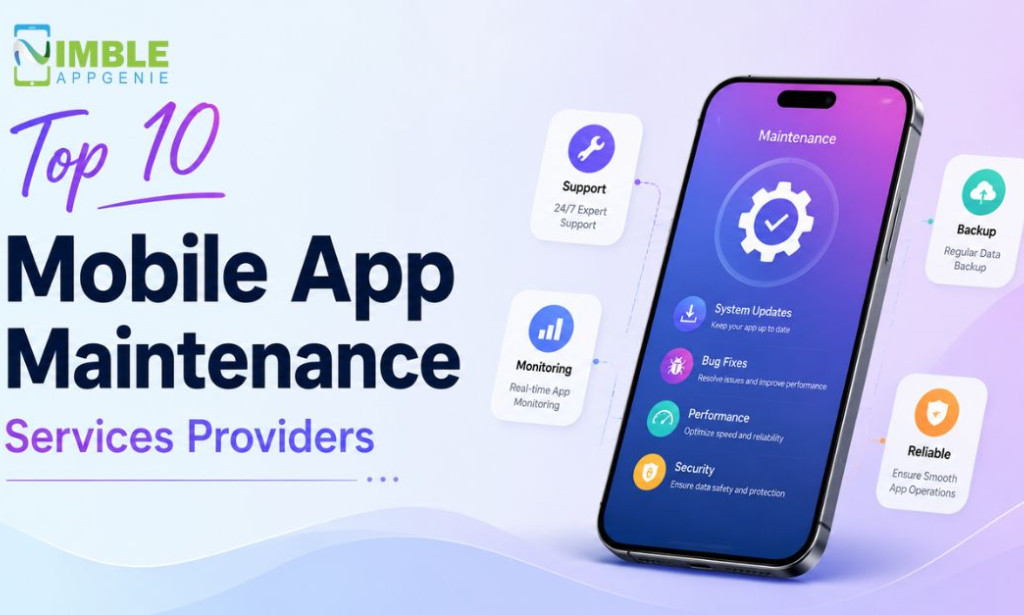
Launching a mobile app is only the beginning. As users increase, operating systems change, third-party APIs evolve, security threats become more sophisticated, and new business requirements emerge, an app needs continuous attention to remain reliable and competitive. This is where mobile app maintenance services become essential.
A strong maintenance partner does more than fix bugs after they appear. The right team monitors application health, manages OS and SDK updates, improves performance, strengthens security, supports integrations, and helps businesses evolve their apps without unnecessary redevelopment.
For this list, we analyzed the current service positioning of established U.S.-based or U.S.-operating technology companies, with particular attention to mobile expertise, post-launch support, application maintenance, scalability, modernization, QA, and long-term product evolution. Rather than simply repeating generic “top app development companies” lists, the selection emphasizes companies that can support an application beyond its initial launch.
1. Nimble AppGenie
Nimble AppGenie is a software development company offering mobile app development and post-launch support for businesses looking to keep their digital products stable, secure, and scalable. Its maintenance approach can cover bug fixing, performance optimization, security improvements, compatibility updates, feature enhancements, and ongoing technical support.
What makes Nimble AppGenie a strong choice for businesses is the ability to connect maintenance with broader product development. Instead of treating maintenance as an isolated technical activity, businesses can use ongoing support to improve the app as their customers, integrations, and business requirements evolve.
For startups and enterprises that need a long-term technology partner, this approach can be particularly valuable. An app may begin with a defined feature set, but scaling businesses often need new integrations, improved workflows, stronger security, backend optimization, and new functionality. A maintenance partner that understands the complete product lifecycle can help manage these changes more efficiently.
Best for: Startups, enterprises, fintech, eCommerce, healthcare, and businesses seeking ongoing mobile product improvement.
2. ScienceSoft
ScienceSoft is one of the more established names in application support and maintenance. Its mobile maintenance offering covers L1-L3 support, corrective and preventive maintenance, application evolution, security management, performance optimization, QA, and compliance management. The company also outlines support models involving SLAs, KPIs, monitoring, and structured service transition.
A major strength is its enterprise-oriented maintenance structure. ScienceSoft can support applications that require more than occasional bug fixing, including complex backend environments, security requirements, integrations, and modernization.
Best for: Enterprises and organizations with complex applications, compliance requirements, and structured support needs.
3. Zco Corporation
Zco Corporation is a long-established U.S. mobile application development company with more than 35 years of experience. Its capabilities cover native iOS and Android, cross-platform technologies, QA, deployment, and continuous post-launch improvement. Zco specifically states that it provides ongoing maintenance, feature updates, performance monitoring, and version upgrades after launch.
Its long mobile development history is an advantage when maintaining older applications or applications that need to transition between technology generations. Zco also supports technologies such as Swift, Kotlin, React Native, Flutter, and .NET MAUI.
Best for: Businesses that need experienced mobile engineers for long-term support, modernization, and feature enhancement.
4. Simform
Simform approaches application maintenance from a broader managed-services and product-sustenance perspective. Its services include application support and maintenance, AI-driven operations, modernization, release engineering, and managed application services. It also describes tiered L1-L3 support with SLA-defined response and resolution times.
This makes Simform particularly relevant for companies whose mobile applications are connected to cloud platforms, APIs, databases, enterprise systems, and other digital infrastructure.
The company's focus on application portfolios rather than isolated fixes is useful for growing businesses where multiple applications and services need to remain aligned.
Best for: Mid-sized and enterprise businesses managing complex application ecosystems.
5. BlueLabel
BlueLabel is a U.S.-based digital product company with offices in New York City, Seattle, and San Francisco. Its experience spans mobile product strategy, design, development, and ongoing product evolution. The company has also published detailed guidance on the practical challenges of app maintenance, including operating-system changes, SDK updates, third-party dependencies, and ongoing technical costs.
One of BlueLabel's useful differentiators is its product-oriented understanding of maintenance. Mobile maintenance isn't limited to repairing broken code; changes in Apple and Google ecosystems can require applications to be updated even when the original product is functioning normally.
Best for: Consumer-facing apps and businesses that want maintenance combined with product strategy, UX, and continued development.
6. DockYard
DockYard is a U.S. digital product consultancy focused on production-ready applications and scalable digital products. Its service portfolio specifically includes Application Maintenance, covering ongoing support, updates, performance checks, and optimization as businesses grow.
DockYard's strength lies in treating maintenance as part of the broader product lifecycle. For businesses with applications that need architectural improvements or continued engineering support, this can be more valuable than a basic ticket-based maintenance arrangement.
Its engineering consultancy model can also help companies that have internal teams but need additional expertise for specific technical challenges.
Best for: Digital businesses that need engineering-led maintenance, modernization, and product scalability.
7. Goji Labs
Goji Labs is a U.S. product development agency with a strong focus on scalable digital products. Its mobile capabilities include native and cross-platform development, while its post-launch services include maintenance, updates, performance monitoring, product optimization, and feature improvements.
The company also provides maintenance structures that can scale according to product needs. Its published guidance notes that clients may begin with a higher number of monthly maintenance hours and reduce them as the product becomes more stable.
This flexible approach can work well for businesses that don't require a large permanent maintenance team but still want access to experienced product engineers.
Best for: Startups, SaaS companies, and growing digital products requiring flexible post-launch support.
8. Mercury Development
Mercury Development has been building software and mobile applications since 1999 and identifies mobile development as a core specialization. Its current capabilities include native iOS and Android, React Native, Flutter, wearable applications, QA, deployment, and ongoing support and maintenance. The company states that its applications have reached more than 40 million users worldwide.
Its experience across mobile, wearables, cloud, and AI makes it an interesting option for businesses maintaining applications that extend beyond conventional smartphone functionality.
For organizations operating mature applications, the ability to combine maintenance with modernization and new technology integration can help prevent technical stagnation.
Best for: High-scale mobile products, wearable-connected applications, and businesses requiring experienced mobile engineering.
9. Softeq
Founded in Houston in 1997, Softeq is a U.S.-headquartered technology company with expertise spanning software, hardware, IoT, AI, connected products, and mobile applications. Its services include post-development production and support, maintenance, and DevOps.
Softeq is particularly differentiated when an application interacts with connected devices, sensors, embedded systems, or other physical technologies. In these environments, maintenance may involve much more than updating a mobile interface.
For businesses building connected ecosystems, having a technology partner capable of working across software and hardware layers can simplify long-term support.
Best for: IoT, connected-device, industrial, healthcare, and technically complex mobile products.
10. Fueled
Fueled is a U.S. digital product company known for mobile product design and development. Its work includes native and cross-platform mobile products, and the company has experience creating applications intended to scale and evolve over time. Fueled has worked with recognizable brands including Warby Parker, Apple, Public, and MGM Resorts.
Its recent mobile work continues to emphasize scalable foundations rather than treating launch as the end of development. That product mindset is important because a mobile application needs to remain adaptable as user expectations, platforms, and business objectives change.
Best for: Consumer brands and businesses prioritizing premium mobile experiences and long-term product evolution.
What Should Businesses Look for in Mobile App Maintenance Services?
Choosing a maintenance company should not be based only on the ability to fix bugs. A scalable maintenance strategy should cover several areas.
1. Proactive Performance Monitoring
The provider should be able to identify crashes, slow screens, API failures, memory problems, and infrastructure issues before they become widespread user problems.
2. OS and SDK Compatibility
Apple and Google continuously change their operating systems, SDKs, development requirements, and store policies. Maintenance teams should regularly review compatibility and prepare applications for relevant updates.
3. Security Maintenance
Security should include vulnerability monitoring, dependency updates, secure configuration, code reviews, and timely remediation. For fintech, healthcare, and other sensitive applications, security maintenance becomes even more important.
4. Bug Fixing and Regression Testing
Fixing one issue should not create another. Strong maintenance teams combine bug resolution with regression testing across supported devices, operating systems, and application versions.
5. Backend and API Maintenance
A mobile application rarely works independently. APIs, databases, authentication systems, payment services, cloud infrastructure, and third-party integrations all influence app performance. Maintenance should therefore cover the complete technical ecosystem where required.
6. Feature Enhancement
A successful app should evolve with its users. Maintenance teams should be able to introduce improvements and new features without compromising existing functionality.
7. Scalability Planning
As downloads, transactions, users, and data increase, an application may require architectural changes, database optimization, cloud scaling, caching, or API improvements. Maintenance should anticipate this growth rather than simply react to failures.
Why Mobile App Maintenance Matters for Scalable Business Growth
A mobile app is a long-term business asset, not a one-time software project. Without continuous maintenance, technical debt can increase, security risks can accumulate, performance can decline, and compatibility problems can eventually affect user retention.
Professional mobile app maintenance services help businesses create a structured process for keeping applications reliable while continuously improving them. Instead of waiting for a critical failure, companies can monitor application health, prioritize improvements, update dependencies, strengthen security, and prepare for future growth.
The strongest providers also understand that maintenance and development are connected. A bug fix may reveal an architectural problem. A performance issue may require backend optimization. A new business requirement may require refactoring an existing module. This is why choosing a partner with both mobile engineering and product lifecycle expertise can deliver greater long-term value.
Final Thoughts
The best mobile maintenance provider depends on your application's complexity, technology stack, industry, user base, security requirements, and growth plans. ScienceSoft and Simform stand out for structured application management, Zco and Mercury Development bring deep mobile engineering experience, while BlueLabel, DockYard, Goji Labs, Softeq, and Fueled offer different combinations of product engineering, modernization, and ongoing support.
For businesses looking for a partner that can combine mobile app maintenance services with continued product development, Nimble AppGenie is worth considering. The right maintenance strategy can do more than keep an app operational—it can help the product remain secure, competitive, adaptable, and ready for the next stage of business growth.

You must be logged in to post a comment.