

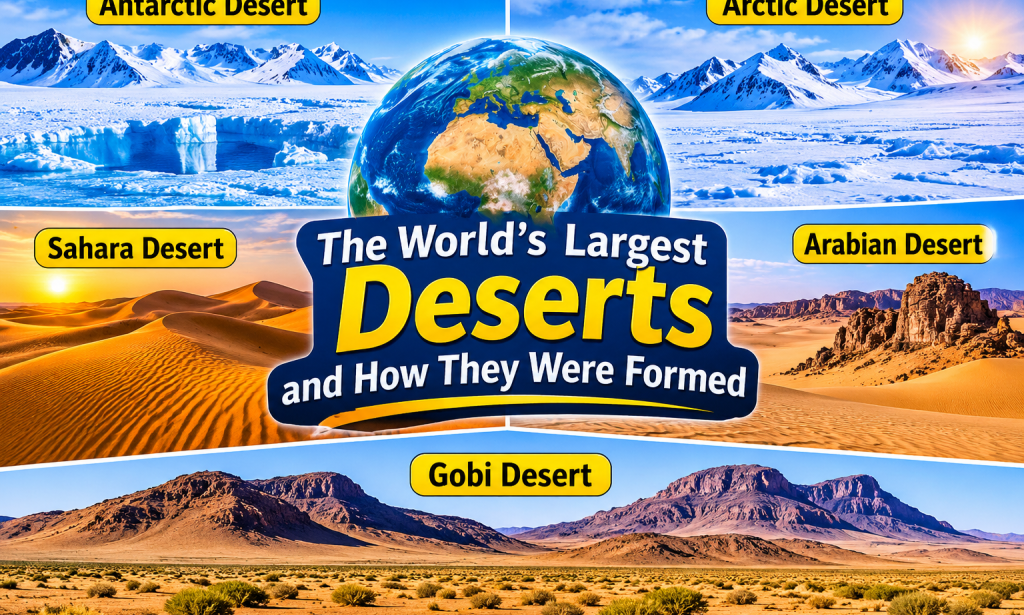
The World's Largest Deserts and How They Were Formed
Deserts are among the most interesting geographical features on Earth. They are known for receiving very little rainfall and having dry environmental conditions. While many people think deserts are only covered with hot sand, some of the world's largest deserts are actually covered with ice and snow.
Deserts can be found on different continents, and each has its own climate, landscape, plants, and animals. Some experience extremely high temperatures during the day, while others remain freezing throughout the year.
Let's explore five of the world's largest deserts and discover how they were formed.
1\. Antarctic Desert
The Antarctic Desert is the largest desert in the world. It is located in Antarctica and is covered by enormous amounts of ice and snow. Despite its freezing temperatures, it is classified as a desert because it receives very little precipitation.
Its dry conditions are caused by extremely cold temperatures, which limit the amount of moisture in the air.
2\. Arctic Desert
The Arctic Desert is located around the North Pole, covering parts of Greenland, Canada, Russia, and other northern regions. It is known for its freezing temperatures, icy landscapes, and limited rainfall.
Its desert conditions developed because cold air holds very little moisture, resulting in low precipitation.
3\. Sahara Desert
The Sahara Desert is the largest hot desert in the world. It stretches across North Africa and covers several countries.
It is famous for its enormous sand dunes, rocky mountains, and extremely hot temperatures. Its dry environment developed over thousands of years through climate changes, reduced rainfall, and changes in atmospheric circulation.
4\. Arabian Desert
The Arabian Desert is located in Western Asia and covers much of the Arabian Peninsula. It is known for its golden sand dunes, rocky landscapes, and very hot weather.
Its dry conditions are largely caused by its geographical location, where descending dry air prevents much rainfall from reaching the region.
5\. Gobi Desert
The Gobi Desert is located in Mongolia and northern China. Unlike many other deserts, it experiences very cold winters and hot summers.
Its formation is influenced by its distance from the ocean and the rain-shadow effect of surrounding mountains, which prevent moist air from reaching the region.
Why Are Deserts Important?
Deserts play an important role in the Earth's environment. They provide homes for specially adapted plants and animals, contain valuable natural resources, and help scientists understand climate patterns.
Although deserts may appear empty, many living things have developed special ways to survive in their harsh conditions.
Conclusion
The world's largest deserts are fascinating natural environments. From the frozen landscapes of Antarctica to the golden sand dunes of the Sahara, each desert has its own unique features and history. Learning about these places helps us understand the Earth's geography, climate, and natural environment.


You must be logged in to post a comment.