
📌 Table of Contents
- Introduction
- What is Primary Education in Nigeria?
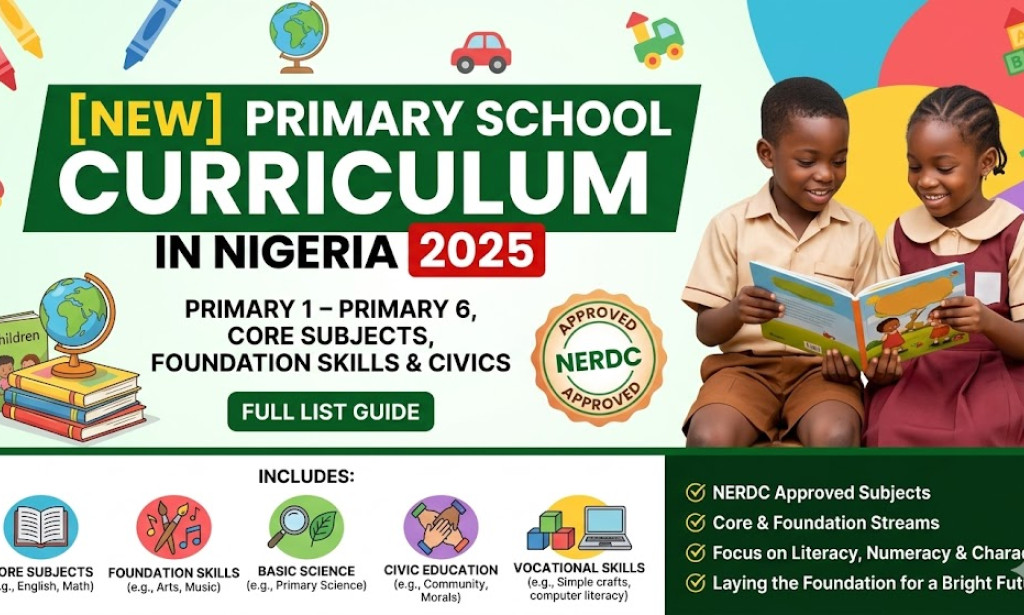
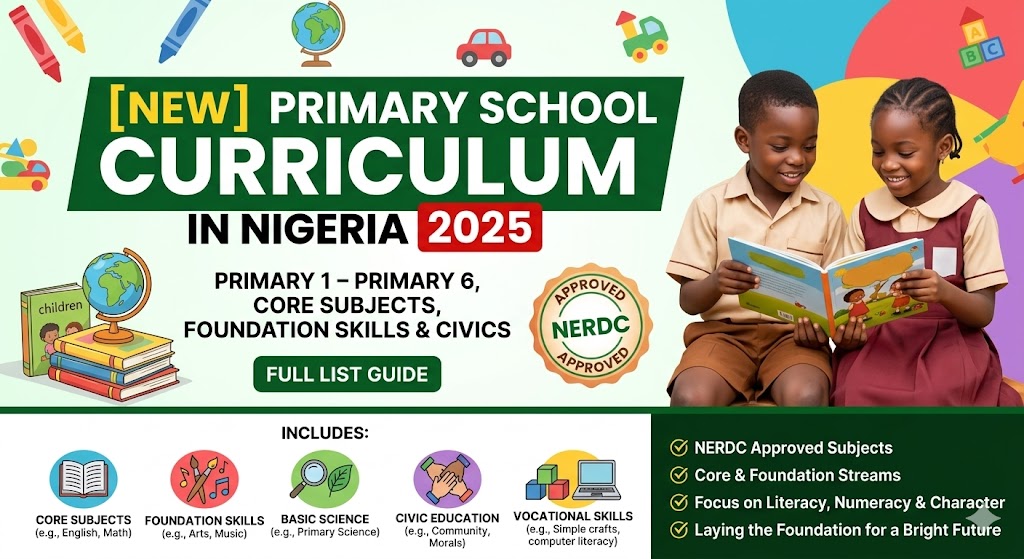
- Overview of the New 2025 Primary School Curriculum
- Structure of the New Primary School Subjects
- Core Subjects in Nigerian Primary Schools
- Languages and Communication Subjects
- Mathematics and Science Subjects
- Civic, Cultural and Religious Subjects
- Vocational and Practical Learning Subjects
- ICT and Digital Literacy in Primary Schools
- Importance of the New Curriculum
- Benefits of Early Skill Acquisition
- Challenges Facing Primary Education in Nigeria
- How Parents Can Help Children Succeed
- FAQs
- Conclusion
1. Introduction
Nigeria’s education system continues to evolve as the government introduces reforms aimed at improving learning quality, practical education, and digital literacy.
In 2025, updates to the Nigerian curriculum guided by the Nigerian Educational Research and Development Council (NERDC) further strengthened primary education by emphasizing foundational learning, creativity, entrepreneurship, and technology.
The new curriculum is designed to help pupils develop:
- Strong literacy and numeracy skills
- Creative thinking abilities
- Moral values
- Practical life skills
- Digital awareness from an early age
This updated curriculum applies to nursery and primary schools across Nigeria.
2. What is Primary Education in Nigeria?
Primary education is the foundational stage of formal education in Nigeria.
It includes:
- Nursery Education
- Primary 1
- Primary 2
- Primary 3
- Primary 4
- Primary 5
- Primary 6
Primary education prepares children for junior secondary school while helping them build basic academic, social, and communication skills.
3. Overview of the New 2025 Primary School Curriculum
The updated curriculum introduced by NERDC focuses on:
- Foundational literacy
- Numeracy improvement
- Practical learning
- ICT and digital literacy
- Civic and moral education
- Creativity and entrepreneurship
The aim is to prepare children for both academic success and future life challenges.
4. Structure of the New Primary School Subjects
Primary school subjects are grouped into:
- Core academic subjects
- Language subjects
- Science and technology subjects
- Civic and cultural studies
- Practical and vocational learning
The curriculum is designed to provide balanced development for every child.
5. Core Subjects in Nigerian Primary Schools
📘 English Language
Pupils learn:
- Reading
- Writing
- Grammar
- Vocabulary
- Communication skills
📗 Mathematics
Topics include:
- Addition and subtraction
- Multiplication and division
- Fractions
- Measurements
- Shapes and basic geometry
6. Languages and Communication Subjects
🗣 Nigerian Languages
Depending on region, pupils may study:
- Yoruba
- Igbo
- Hausa
🇫🇷 French Language
French is introduced in many schools to improve international communication skills.
7. Mathematics and Science Subjects
🔬 Basic Science and Technology
Pupils learn:
- Human body basics
- Plants and animals
- Environment
- Energy and technology
💻 ICT / Computer Studies
The new curriculum emphasizes:
- Computer awareness
- Keyboard usage
- Digital safety
- Basic computer operations
8. Civic, Cultural and Religious Subjects
🌍 Civic Education
Children learn:
- Good behavior
- Respect for others
- National values
- Citizenship
🎭 Cultural and Creative Arts
Subjects include:
- Music
- Drawing
- Craft work
- Drama
✝️ Religious Studies
Pupils study:
- Christian Religious Studies (CRS) or
- Islamic Religious Studies (IRS)
9. Vocational and Practical Learning Subjects
The updated curriculum also introduces practical learning areas such as:
- Home activities
- Handcrafts
- Gardening
- Basic entrepreneurship awareness
- Creative projects
These subjects help children develop practical thinking and creativity.
10. ICT and Digital Literacy in Primary Schools
Technology is now an important part of primary education.
Pupils are introduced to:
- Basic computer skills
- Educational software
- Internet awareness
- Digital communication basics
This helps children become familiar with technology early in life.
11. Importance of the New Curriculum
The new curriculum helps pupils:
- Build strong academic foundations
- Improve creativity and innovation
- Develop communication skills
- Learn practical problem-solving
- Prepare for future education and careers
12. Benefits of Early Skill Acquisition
Early practical learning helps children:
- Become more independent
- Develop confidence
- Discover talents early
- Improve creativity
- Build entrepreneurial thinking
13. Challenges Facing Primary Education in Nigeria
❌ Common Challenges
- Lack of ICT facilities
- Inadequate learning materials
- Overcrowded classrooms
- Poor teacher training in some areas
✅ Possible Solutions
- Better educational funding
- Improved teacher training
- Increased access to digital learning tools
- Better school infrastructure
14. How Parents Can Help Children Succeed
Parents can support children by:
- Encouraging daily reading
- Monitoring homework
- Providing learning materials
- Reducing distractions
- Supporting digital learning responsibly
15. FAQs
1. Who designed the new curriculum?
The curriculum was developed by NERDC with support from the Federal Ministry of Education.
2. Is ICT now compulsory in primary schools?
ICT and digital literacy are now strongly emphasized in the updated curriculum.
3. Does the curriculum include vocational learning?
Yes, practical and creative learning areas are included.
4. What is the purpose of the new curriculum?
The goal is to improve foundational learning, creativity, technology skills, and entrepreneurship awareness.
16. Conclusion
The New Primary School Curriculum in Nigeria 2025 represents a major improvement in foundational education.
By combining academics, technology, creativity, civic education, and practical learning, the curriculum prepares Nigerian children for future academic success and real-world challenges.
With proper implementation, the new system can help build a generation of skilled, confident, and innovative learners ready for the modern world.

You must be logged in to post a comment.