

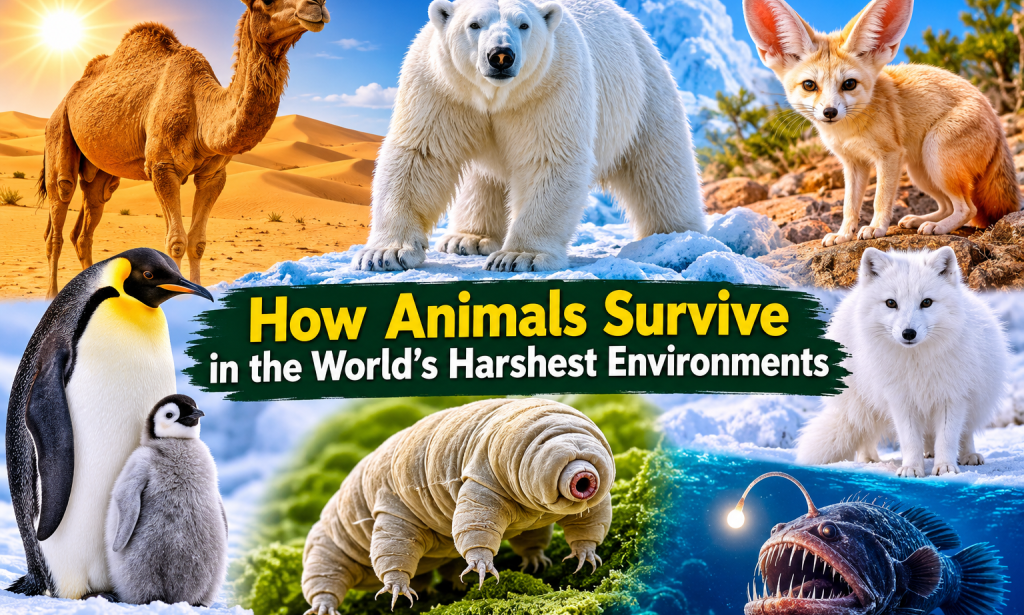
How Animals Survive in the World's Harshest Environments
Imagine living in a place where the ground is covered with ice, the temperature is extremely hot, or water is almost impossible to find. For humans, these conditions can be dangerous. However, some animals have developed extraordinary abilities that allow them to survive in these challenging environments.
Nature has equipped different animals with special features that help them find food, protect themselves and survive extreme temperatures. Some can survive without drinking water regularly, while others can withstand freezing temperatures or spend long periods without food.
Let's explore some amazing examples.
1\. The Camel: The Desert Survivor
Camels are among the best-known desert animals. They can survive in extremely hot environments where water is scarce.
Their humps store fat, which provides energy when food is unavailable. Camels can also conserve water and tolerate significant changes in body temperature.
Their wide feet help them walk across soft sand without sinking easily.
2\. The Polar Bear: Master of the Arctic
Polar bears live in the freezing Arctic, where temperatures can become extremely low.
They have thick fur and a layer of body fat that helps keep them warm. Their large paws help them walk on ice and swim through cold water.
Their fur appears white, helping them blend into snowy surroundings while hunting.
3\. The Tardigrade: A Tiny Creature with Incredible Abilities
The tardigrade, also known as a water bear, is a tiny animal famous for surviving extreme conditions.
When its environment becomes too harsh, it can enter a special dormant state called cryptobiosis. During this state, its metabolism slows dramatically.
Some tardigrades have survived extreme cold, heat, radiation and even the vacuum of space under experimental conditions.
4\. The Fennec Fox: Surviving the Desert Heat
The fennec fox is a small desert animal with unusually large ears.
These ears help release body heat and allow it to detect prey underground. Its fur protects it from hot daytime temperatures and cold desert nights.
It is also adapted to obtain much of the water it needs from its food.
5\. The Emperor Penguin: Living Through Antarctic Winters
Emperor penguins survive some of the coldest conditions on Earth.
They have dense feathers and a thick layer of fat that helps protect them from freezing temperatures. During the harsh Antarctic winter, groups of penguins huddle closely together to conserve warmth.
This teamwork helps protect them from freezing winds.
6\. The Arctic Fox: Built for Extreme Cold
The Arctic fox lives in very cold regions of the Northern Hemisphere.
Its thick fur covers much of its body, including its paws. Its small ears and compact body help reduce heat loss.
Its coat also changes colour with the seasons, helping it blend into its surroundings.
7\. The Kangaroo Rat: Surviving Without Drinking Water
The kangaroo rat is a small animal that lives in dry desert environments.
It can survive without regularly drinking water because it gets moisture from the seeds it eats and produces water during metabolism.
It also stays inside underground burrows during the hottest parts of the day.
8\. The Wood Frog: Surviving Being Frozen
The wood frog has one of the most surprising survival abilities in the animal kingdom.
During winter, parts of its body can freeze. Its heart may stop beating temporarily, and it stops breathing. Special substances such as glucose help protect its cells from damage.
When temperatures rise, the frog thaws and becomes active again.
9\. The Camel Spider: Living in Harsh Desert Conditions
Camel spiders are found in dry desert regions. They are adapted to environments with intense heat and limited resources.
They often avoid the hottest hours by hiding under rocks or in burrows. They are fast-moving predators that feed on insects and other small animals.
Despite their name, they are not true spiders and do not feed on camels.
10\. The Deep-Sea Anglerfish: Surviving in Ocean Darkness
Deep-sea anglerfish live far below the ocean's surface, where sunlight cannot reach and water pressure is extremely high.
Some species have a special glowing structure that helps attract prey in the darkness. Their large mouths and expandable stomachs allow them to swallow prey when food is difficult to find.
These features help them survive in one of Earth's most challenging environments.
What Can We Learn from These Animals?
These animals demonstrate how powerful adaptation can be. Every creature has different features that help it survive in its natural environment.
Their survival abilities also remind us why protecting wildlife and natural habitats is important. Climate change, pollution and habitat destruction can make survival more difficult for animals that depend on specific environmental conditions.
Conclusion
The natural world is full of amazing creatures with extraordinary survival abilities. From camels crossing hot deserts to polar bears living in icy regions, animals have developed remarkable ways to overcome difficult conditions.
Their stories show that nature is not only beautiful but also incredibly fascinating. Even in places where survival seems almost impossible, life can find a way to continue.











































You must be logged in to post a comment.