

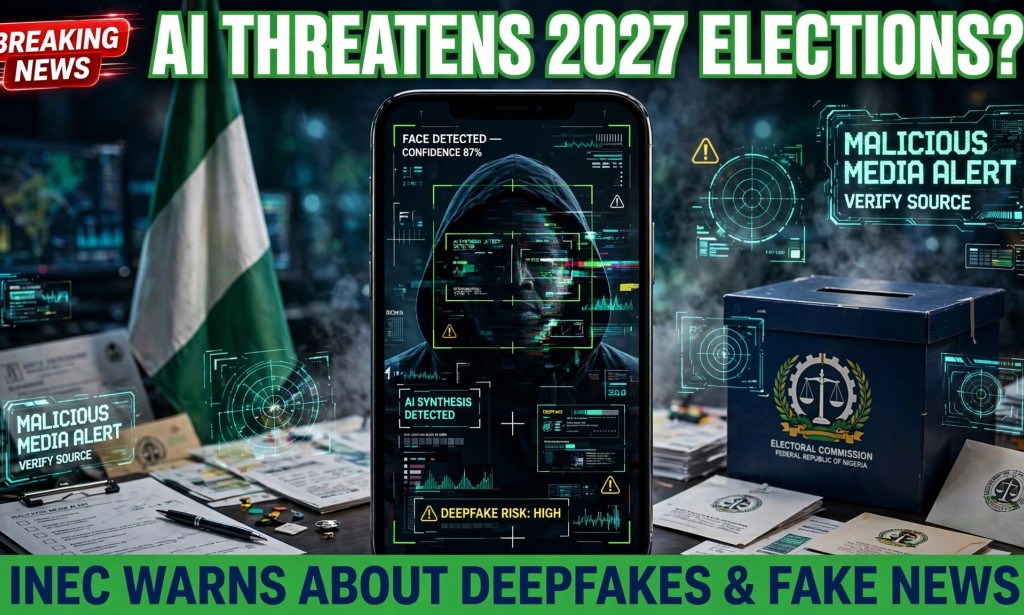
INEC Warns AI Could Threaten Nigeria’s 2027 Elections: How Deepfakes and Fake News Could Mislead Voters
Imagine scrolling through WhatsApp and seeing a video of an INEC official announcing that election day has been postponed. The video looks real. The person's voice sounds familiar, and thousands of people are already sharing it.
But what if the announcement is completely fake?
This is one of the concerns facing Nigeria as the country prepares for the 2027 general elections. Artificial intelligence is making it easier to create convincing fake videos, photographs and audio recordings, raising serious questions about how voters will distinguish genuine information from manipulated content.
The Independent National Electoral Commission (INEC) has now raised the alarm about these dangers.
INEC Raises Concern Over AI-Generated Fake News
On November 2, 2026, INEC Chairman Professor Joash Ojo Amupitan warned about the growing threat of artificial intelligence-driven disinformation and digital manipulation ahead of the 2027 elections.
He spoke at a national summit on electoral information integrity in Abuja, where stakeholders discussed how AI and other forms of information manipulation could affect Nigeria's democratic process.
According to the commission, manipulated videos, cloned voices, fabricated images and coordinated online campaigns could mislead voters and damage confidence in electoral institutions.
INEC explained that the threat could emerge at different stages of the electoral process, including voter registration, political campaigns, voting, announcement of results and the resolution of election disputes.
The warning shows that protecting an election involves more than securing ballot papers and polling stations. It also requires ensuring that voters receive accurate information.
How Could Artificial Intelligence Affect the 2027 Elections?
Artificial intelligence has many useful applications, but it can also be misused.
Here are some ways it could create problems during an election.
1. Fake Videos of Political Candidates
AI tools can generate or manipulate videos to make it appear that someone said or did something they never actually said or did.
For example, a fabricated video could show a political candidate making an offensive statement or announcing that they are withdrawing from an election.
If such a video spreads widely before it is checked, it could influence public opinion and damage someone's reputation.
2. Cloned Voices and Fake Audio Recordings
Voice-cloning technology can imitate a person's voice using audio samples.
This creates opportunities for dishonest individuals to produce fake recordings that appear to feature political candidates, government officials or INEC representatives.
A fabricated audio message announcing false voting instructions could confuse people, particularly if it is circulated through WhatsApp groups without verification.
3. Fake Election Announcements
Another concern is the creation of false announcements about voting arrangements, polling locations, postponed elections or election results.
Imagine receiving a message claiming that voting has been cancelled in your area. If you believe it without checking official information, you could miss an important civic activity.
This is why voters should confirm election-related announcements through INEC's official communication channels.
4. Manipulated Photographs and Documents
AI can also be used to create convincing photographs and alter documents.
Fake result sheets, fabricated letters and misleading images could circulate online, creating confusion and unnecessary tension.
A photograph appearing to show an electoral incident should not automatically be treated as proof that the event happened.
INEC Is Also Exploring AI as Part of the Solution
Interestingly, INEC is not describing artificial intelligence as entirely harmful.
The commission has also discussed how AI could support election administration, including analysing electoral data, improving logistics and identifying possible irregularities.
In October 2026, INEC announced the establishment of a dedicated AI division within its Information and Communications Technology Department. The commission also described plans for human oversight of AI-supported processes.
The chairman has emphasised that technology should support election management rather than replace human responsibility.
This distinction is important. AI can assist with certain tasks, but electoral decisions must remain subject to proper procedures, accountability and legal oversight.
What Are Technology Companies Doing?
The response is not limited to INEC.
Meta, Google and Microsoft have also announced different forms of support aimed at tackling misleading information and AI-generated manipulation ahead of the elections.
For example, Google has made its SynthID Detector available to help identify certain AI-generated content carrying supported SynthID watermarks.
However, detection tools have limitations. Not every manipulated image or recording contains an identifiable watermark, so no single tool can establish whether every piece of online content is genuine.
This makes independent verification and responsible reporting especially important.
How Nigerians Can Protect Themselves From Election Misinformation
Every social media user has a role to play in preventing false information from spreading.
Here are five useful habits:
- Check the original source: Before believing an election announcement, look for confirmation from INEC or other credible sources.
- Be careful with forwarded messages: A message shared by friends or relatives is not automatically accurate.
- Look for independent reporting: Check whether established news organisations are reporting the same development.
- Do not rush to share shocking content: Emotional videos and dramatic headlines deserve extra scrutiny.
- Understand that AI detectors are not perfect: A tool's result should not replace careful verification.
The Bigger Question: Can Nigeria Protect the 2027 Election From AI Manipulation?
Nigeria's 2027 general elections will take place in an increasingly digital information environment. Political discussions, campaign messages and election updates will continue to circulate across social media and messaging platforms.
Artificial intelligence could help improve certain aspects of election administration, but its misuse could make it harder for citizens to identify trustworthy information.
INEC, technology companies, journalists, political parties and ordinary Nigerians will all have responsibilities in addressing the challenge.
The most important lesson is simple: do not allow a convincing video, familiar voice or viral message to replace verified information.
As the 2027 elections approach, how well Nigeria responds to AI-generated misinformation could become an important part of protecting public confidence in the electoral process.
What do you think? Is Nigeria prepared for the challenges AI could bring to the 2027 elections? Share your opinion in the comments, like this article, follow my LodPost profile and share it with others who should understand this issue.
I also welcome donations to support my writing. I started writing to help provide for my mother, who has cancer, and raise money towards her surgery. Every donation, no matter the amount, would mean a great deal and help me continue creating useful content. Thank you for reading and supporting my work.


You must be logged in to post a comment.