
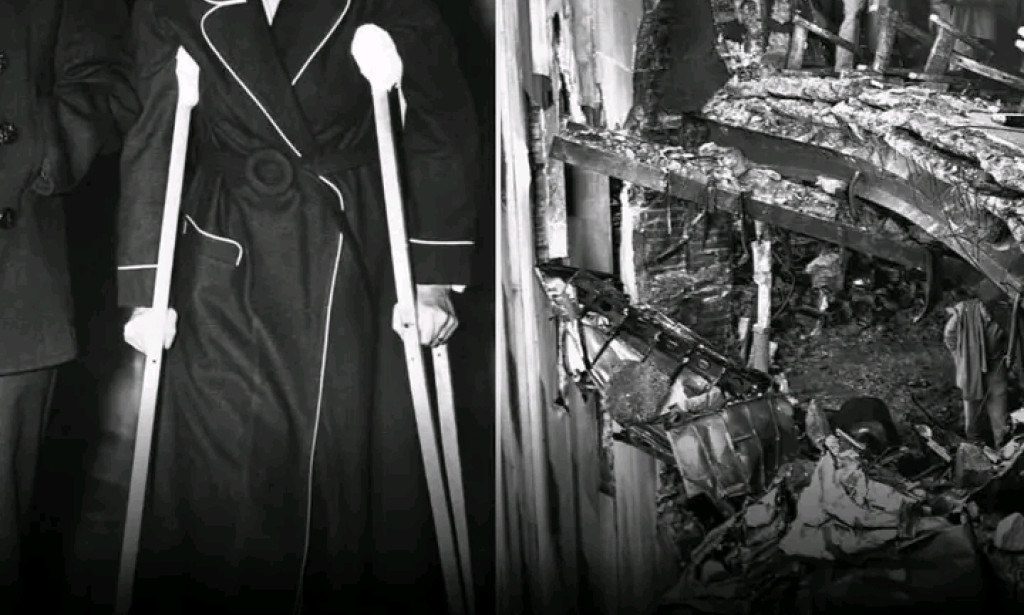
July 28, 1945.
New York City was shrouded in thick fog.
The kind of fog that swallows skyscrapers whole and turns familiar streets into ghostly outlines.
At 9:40 in the morning, U.S. Army Lieutenant Colonel William Franklin Smith Jr. was piloting a B-25 Mitchell bomber through that fog.
He was trying to navigate to Newark Airport.
But in 1945, planes didn't have the sophisticated navigation systems we have today.
In dense fog, pilots flew almost blind.
Smith descended, searching for visual landmarks.
But the fog was too thick.
He was disoriented.
Flying too low.
And headed directly toward the tallest building in the world.
The Empire State Building.
Workers inside were starting their Saturday morning shifts.
Typewriters clacked.
Phones rang.
On the 79th floor, 20-year-old Betty Lou Oliver was working as an elevator operator.
It was a good job for a young woman in 1945.
Respectable. Stable.
She wore a crisp uniform, greeted passengers with a smile, and guided the elevator car up and down the massive building all day long.
It was routine work.
Until it wasn't.
At 9:40 AM, the B-25 bomber emerged from the fog.
Traveling at nearly 200 miles per hour.
Headed straight for the north side of the Empire State Building.
Lieutenant Colonel Smith had only seconds to react.
But there was nothing he could do.
The bomber slammed into the 79th floor with catastrophic force.
The impact tore a hole 18 feet wide in the building's exterior.
One of the plane's engines shot completely through the building and out the other side, landing on a nearby rooftop.
The other engine plunged down an elevator shaft.
Thousands of gallons of aviation fuel ignited instantly.
A massive fireball exploded through the upper floors.
Flames roared through offices.
Debris rained down onto the streets of Manhattan far below.
People on the ground screamed and scattered as twisted metal and shattered glass fell from the sky.
Inside the building, workers on the 79th floor were killed instantly.
Others were trapped by flames and collapsing structure.
Smoke filled the corridors.
Panic spread through every floor.
Betty Lou Oliver was working near the crash site when the bomber hit.
The explosion threw her across the room.
Shrapnel tore into her body.
Burns seared her skin.
She was gravely injured—suffering from severe burns, a broken pelvis, and a crushed vertebra.
But she was alive.
First responders and building personnel rushed to evacuate survivors from the burning upper floors.
They found Betty Lou conscious but in agony.
There was no time for a careful medical assessment.
The building was on fire.
They needed to get her out immediately.
Someone made a decision.
They would use the elevator.
It seemed like the fastest way to get an injured woman down 79 floors to medical help.
They carefully placed Betty Lou inside elevator car number 6.
The doors closed.
The elevator began its descent.
And then, the unthinkable happened.
The cables snapped.
The same explosion that had injured Betty Lou had also severely weakened the elevator's support system.
The heat. The impact. The structural damage.
It was all too much.
The cables gave way.
And Betty Lou Oliver—already burned, broken, and in shock—began to plummet down the elevator shaft.
75 floors.
Over 1,000 feet.
In total freefall.
The elevator car accelerated as it dropped.
Faster and faster.
40 miles per hour.
The metal shaft became a tunnel of certain death.
Betty Lou was conscious.
She knew what was happening.
She knew there was no way to survive.
Imagine that moment.
The terror of falling.
The absolute certainty of impact.
The knowledge that in seconds, it would all be over.
But then something extraordinary happened.
As the elevator car fell, the severed cables piled up at the bottom of the shaft.
Coil after coil of thick steel cable formed a tangled cushion.
And as the elevator car smashed into the bottom, that coiled metal absorbed some of the devastating impact.
Not all of it.
But enough.
In addition, the rapid descent of the elevator car had compressed the air in the narrow shaft beneath it.
That compressed air created a cushioning effect—like a giant pneumatic brake.
Again, not enough to stop the car gently.
But enough to reduce the force just slightly.
Just enough.
When rescuers pried open the twisted wreckage at the bottom of the elevator shaft, they expected to find a body.
Instead, they found Betty Lou Oliver.
Alive.
Severely injured—her earlier wounds compounded by new trauma from the fall.
But breathing.
Conscious.
Impossibly, miraculously alive.
She had just survived the longest elevator fall in recorded history.
And lived to tell about it.
The rescue workers couldn't believe it.
The doctors couldn't believe it.
Even Betty Lou herself could barely process what had happened.
She had survived a plane crash into a skyscraper.
And then survived a 75-story elevator plunge.
Two catastrophes that should have killed her.
And somehow, she walked away.
Well, not walked exactly.
She spent months in the hospital recovering from her injuries.
The burns. The broken bones. The internal trauma.
But she did recover.
She went on to live a full life—marrying, raising a family, and carrying with her one of the most astonishing survival stories in American history.
The 1945 Empire State Building crash killed 14 people that day.
Three crew members aboard the bomber.
Eleven people inside the building.
It could have been so much worse.
The building could have collapsed.
The fire could have spread uncontrollably.
But the Empire State Building's steel frame held.
Firefighters extinguished the blaze in just 40 minutes.
And by Monday morning, most of the building had reopened for business.
But Betty Lou Oliver's story became the most remarkable chapter of that tragedy.
Her survival has been documented in the Guinness Book of World Records.
Her fall remains the longest survived elevator drop in history.
To this day, engineers and safety experts study what happened.
How the combination of coiled cables and compressed air created just enough cushioning.
How the elevator car's structure held together enough to protect her.
How every variable aligned in the most improbable way.
It shouldn't have worked.
By every calculation, she should have died.
But she didn't.
Sometimes, survival comes down to chance.
To physics working in your favor.
To being in exactly the right position at exactly the right moment.
Betty Lou Oliver lived until 1999.
She was 74 years old when she passed away—more than five decades after the day she should have died.
Five decades of life that defied every odd.
Five decades that began with a miracle at the bottom of an elevator shaft.
Her story reminds us that even in the most catastrophic moments, survival is sometimes possible.
That the human body can endure forces we think would destroy it.
That hope exists even in freefall.
The Empire State Building still stands today.
Millions of tourists visit every year.
They ride the elevators to the observation deck and look out over Manhattan.
Most of them have no idea that once, in that very building, a young woman fell 75 floors.
And lived.
But now you know.
You know about Betty Lou Oliver.
The elevator operator who survived the impossible.
Twice.
A testament to resilience, luck, and the strange physics that occasionally bend in our favor.
Her story is a reminder.
That even when everything goes wrong.
Even when disaster strikes again and again.
Sometimes—just sometimes—you survive.
And that survival becomes a story worth telling.
Again and again.
For generations to come.

You must be logged in to post a comment.