
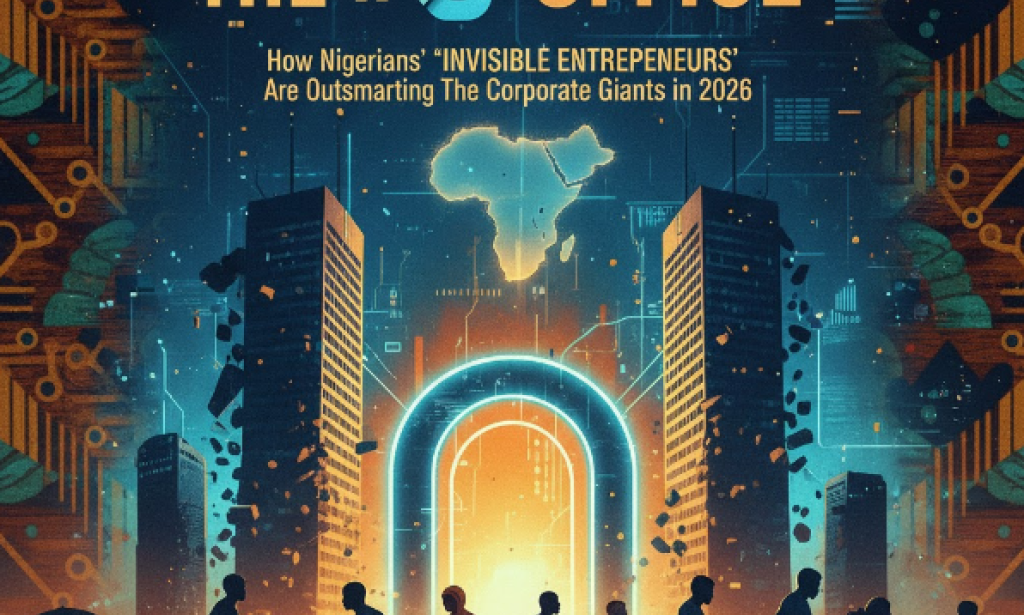
The #0 Office: How Nigerian's "Invisible Entrepreneurs" Are Outsmarting the Corporate Giants in 2026
Have you noticed the silence?
It’s the sound of massive glass office towers in Victoria Island becoming "Ghost Towers." While corporate boards hold 4-hour meetings to "mitigate" the 15.1% inflation rate, a 22-year-old in a cafe in Enugu just made ₦200,000 before lunch.
She didn’t hire a distributor. She didn’t rent a warehouse. She didn't even open a laptop.
In 2026, the Nigerian economy has split. You are either a Dinosaur (heavy, slow, and dying) or a Disruptor (light, fast, and invisible). Which one are you?
1. The "Sachet-ization" of Wealth
We used to only buy milk in sachets. In 2026, we are "Sachet-izing" entire businesses.
The most searched term this year isn't "Stock Market"; it’s "Daily Income." We’ve finally realized that waiting for a monthly salary in a volatile economy is like trying to catch rain with a fork. It just doesn't hold.
The 2026 Survival Formula:
The Logic: If your business can’t make money while you’re stuck in Lagos traffic, is it even a business?

2. The Rise of the "Invisible Business"
While the "Big Guys" are sweating over diesel costs and property taxes, the "Invisible Business" is winning. These ventures exist in the "cracks" of the internet—WhatsApp Channels, Telegram bots, and TikTok Live.
They don't have "staff"; they have AI agents.
They design logos in 30 seconds.
They write sales scripts while the owner is at the gym.
They handle customer service while the owner sleeps.
In 2024, AI was a "threat." In 2026, it's the Nigerian entrepreneur’s Senior Staff. If you aren't using it, you’re paying a "clumsiness tax" every single day.
3. The "Dollar-Hedge" Hustle: Why We Stopped Crying
We used to refresh the exchange rate and cry. Now, we refresh our Upwork or Fiverr dashboards and smile.
Search data shows a 640% spike in AI interest. Why? Because we’ve figured out the ultimate "Life Hack": Earn in Dollars, Spend in Naira.
By becoming "Exportable Assets," we are bypassing the local middleman entirely. Why sell your time to a local company that "will get back to you next week" when you can sell a digital product to a client in Singapore by dinner time?
4. The "Achalugo" Speed: Turning Trends into Tenders
The biggest advantage of being small is Speed.
When a new slang like "Achalugo" or a viral trend hits the streets, corporations are still sending emails to their legal team for "brand alignment." Meanwhile, the Micro-Entrepreneur has already:
- Sourced the product via a mini-importation link.
- Created a "Viral Hook" video on TikTok.
- Sold out their first 500 units via WhatsApp Status.
The Speed Gap:
- Corporations: Strategy --Meeting--Approval--Sales (3 Months later)
Micro-Business: Trend--TikTok--DM for Price--Sales (3 Hours later)
5. Why "Small" is the New "Big"
Why are micro-businesses outperforming? It's The Agility Factor.
In 2026, scale is a liability. Having 50 employees means 50 people to worry about when the price of fuel jumps. Having 5 AI tools and 2 freelancers means you can pivot your entire business model over a weekend.
We are seeing a shift from Stability to Adaptability. The "Middleman" who used to add 30% to the price just for "knowing a guy" is dead. The creator who is the guy is now in charge.

The Verdict: Are You a Dinosaur or a Disruptor?
The 2026 economy isn't "punishing" Nigeria; it’s filtering us. It is filtering out the people who rely on old, heavy systems and rewarding those "Light" enough to move with the wind.
You don't need a ₦10 million loan. You don't need a shop in Lekki. You need a skill the world wants and the speed to deliver it before the next person.
Are you still waiting for a "Job," or are you ready to build a "Node"?

You must be logged in to post a comment.