
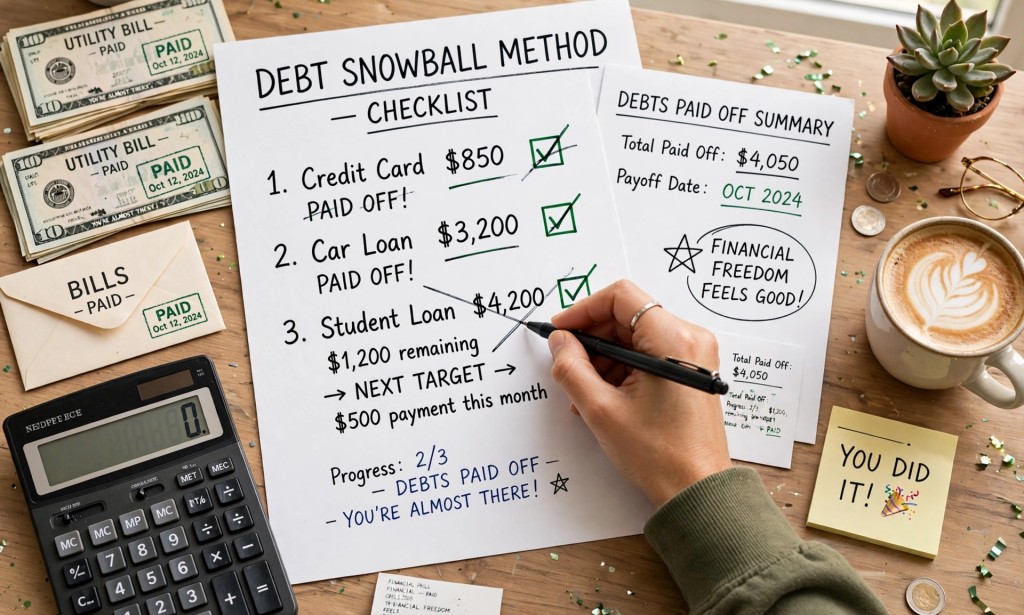
How I Paid Off $5,000 in Credit Card Debt Using the Debt Snowball Method
I had $5,000 in credit card debt, and the stress of making payments every month was becoming overwhelming. Interest charges kept adding up, and I felt like I was working hard without making much progress.
Then I discovered the debt snowball method. By organizing my debts from smallest to largest and focusing on one balance at a time, I developed a repayment strategy that helped me work toward becoming debt-free.
Here is how the method works, how I organized my debts, and how you can adapt the strategy to your own financial situation.
What Is the Debt Snowball Method?
The debt snowball method is a debt repayment strategy in which you list your debts from the smallest balance to the largest, regardless of their interest rates.
You continue making the minimum required payments on all your debts while directing any extra repayment money toward the smallest balance first.
Once you pay off the smallest debt, you take the money you were using for that payment and add it to the amount you pay toward the next-smallest debt.
As each debt disappears, the amount available for the next one grows, much like a snowball rolling downhill.
The main advantage of this method is psychological: paying off smaller debts can give you a sense of progress and motivate you to continue.
My $5,000 Debt List
Before I started, I listed every debt and its outstanding balance. Seeing everything in one place helped me understand the size of the problem and decide where to begin.
| Debt | Balance |
|---|---|
| Store card | $400 |
| Phone payment | $650 |
| Credit card 1 | $1,200 |
| Credit card 2 | $2,750 |
| Total Debt | $5,000 |
My plan was to clear the $400 store card first, followed by the $650 phone balance, the $1,200 credit card, and finally the $2,750 credit card.
Step 1: I Looked for Extra Money in My Budget
I knew that making only the minimum payments would make repayment slower, especially with interest accumulating. I needed to find additional money to put toward my debt.
I reviewed my spending and looked for ways to increase the amount I could pay each month.
- Cancelled my gym membership: Saved $40 per month.
- Reduced food delivery: Saved approximately $120 per month.
- Sold an old gaming console: Received $180 as a one-time payment.
- Worked overtime: Earned approximately $100 extra per month.
These changes could free up money for debt repayment, although selling a gaming console provides a one-time amount rather than recurring monthly income.
My target was to direct an additional $300 per month toward debt repayment while keeping some money available for unexpected expenses.
The lesson: You do not always need a huge salary to make progress. Reviewing your spending and finding realistic ways to increase your income can help you pay down debt faster.
Step 2: I Focused on the Smallest Debt First
The first balance on my list was the $400 store card. Instead of spreading all my extra money across every debt, I concentrated my additional payments on that balance while maintaining the required minimum payments on the others.
For example, if the minimum payment was $50 and I had another $300 available, I could direct $350 toward the store card, provided that doing so still allowed me to meet my other obligations.
Paying off a small balance can create an encouraging first win. Rather than feeling overwhelmed by the entire $5,000, I could focus on eliminating one debt at a time.
However, the actual payoff date depends on interest charges, payment due dates, fees, and the minimum payments required on the other accounts.
Step 3: I Let the Snowball Grow
After paying off the store card, I could redirect the money that had gone toward that balance to the next debt.
Debt 1: The $400 Store Card
I started with the smallest balance. Once it was paid off, I stopped making payments toward that debt and moved the available repayment money to the next account.
Debt 2: The $650 Phone Payment
Next, I focused on the $650 phone balance. I combined the money previously used for the store card with my regular debt repayment budget.
Debt 3: The $1,200 Credit Card
With two smaller balances cleared, I could direct more money toward the $1,200 credit card. The growing payment amount helped me make faster progress on this balance.
Debt 4: The $2,750 Credit Card
Finally, I focused on the largest balance. By this stage, the money previously used for the smaller debts could be redirected toward the remaining credit card, making it easier to pay down the principal.
Important: The snowball method does not automatically guarantee that all debts can be cleared within eight months. The timeline depends on your available monthly payment, interest rates, fees, and the timing of each payment.
Can You Pay Off $5,000 in Eight Months?
It may be possible to repay $5,000 in eight months, but you need to calculate how much you can afford to pay.
Ignoring interest and fees, the basic calculation is:
$5,000 ÷ 8 months = $625 per month.
That means you would need to pay an average of at least $625 per month toward the original balance. Because interest and fees may continue to accrue, the actual amount required could be higher.
Before committing to an eight-month target, list the interest rates, minimum payments, and balances for all your accounts. Then create a repayment budget that covers your essential expenses and required payments.
If you cannot afford $625 or more per month, choose a longer repayment period that fits your circumstances rather than putting your essential bills at risk.
Why Does the Debt Snowball Method Work?
The debt snowball method works for many people because it emphasizes motivation and visible progress.
1. You See Results Earlier
Paying off a small balance can provide a sense of accomplishment. That first success may make it easier to stick with your repayment plan.
2. Your Repayment Budget Becomes More Focused
Instead of spreading every extra dollar across multiple debts, you concentrate your additional payments on one target at a time.
3. You Build a Consistent Habit
Following a structured plan helps you make deliberate decisions about your money rather than paying bills without a clear strategy.
4. You Can Track Your Progress
Every time a balance reaches zero, you can update your debt list and focus on the next target. This makes a large financial goal feel more manageable.
Is the Debt Snowball Method Better Than the Debt Avalanche Method?
The debt snowball method is not the only way to repay debt. Another option is the debt avalanche method, which prioritizes debts with the highest interest rates.
| Feature | Debt Snowball | Debt Avalanche |
|---|---|---|
| First priority | Smallest balance | Highest interest rate |
| Main advantage | Quick motivational wins | Can reduce total interest costs |
| Best suited for | People motivated by clearing debts quickly | People focused on minimizing interest |
If your main goal is motivation, the snowball method may suit you. If your debts have very different interest rates and you want to minimize interest costs, the avalanche method may save you more money.
Whichever method you choose, keep making at least the required minimum payments on all accounts.
What I Learned From Paying Off Debt
My biggest lesson was that a clear plan can make a difficult financial situation feel more manageable.
I learned to examine my spending, identify expenses I could reduce, and direct extra money toward a specific goal. I also learned that a debt-free future requires habits that continue even after the balances reach zero.
Once you have paid off your debts, consider redirecting the money you used for monthly repayments toward emergency savings and other financial goals. That can help reduce the likelihood of relying on credit cards when unexpected expenses arise.
Final Thoughts: Start Your Debt Snowball Today
Paying off debt can feel overwhelming, especially when interest charges make progress seem slow. But organizing your balances and choosing a repayment strategy can help you take control of the process.
Start by listing all your debts from smallest to largest. Continue making the minimum payments on every account, then direct any additional money toward the smallest balance. When that debt is paid off, roll the payment amount into the next one.
Remember that everyone's financial circumstances are different. Focus on a repayment plan you can maintain without neglecting essential expenses or taking on new high-interest debt.
You do not have to solve every financial problem today. Take the first step, keep track of your progress, and work toward your goal one balance at a time.
What About You?
Have you tried the debt snowball method, or do you prefer paying off the debts with the highest interest rates first?
Share your experience in the comments. Your advice could help someone else take the first step toward becoming debt-free.
Disclaimer: This article is for educational purposes only. The figures are illustrative, and repayment results depend on interest rates, fees, payment amounts, and individual financial circumstances.


You must be logged in to post a comment.