
The streets are making the headlines. The bond market may be telling the more important story.
France is facing a moment that extends far beyond broken shop windows and angry crowds.
Over the weekend, protests driven by rising living costs, fuel prices and frustration over public services escalated into some of the country’s most serious unrest in years. Businesses were looted or damaged, thousands were arrested and authorities have been forced to confront a rapidly deteriorating situation.
But while television cameras remain focused on the streets of Paris and other major cities, another drama is unfolding much more quietly.
Investors are starting to put a price on France’s instability.
The market is sending a warning
On Monday, French government bonds came under heavy selling pressure.
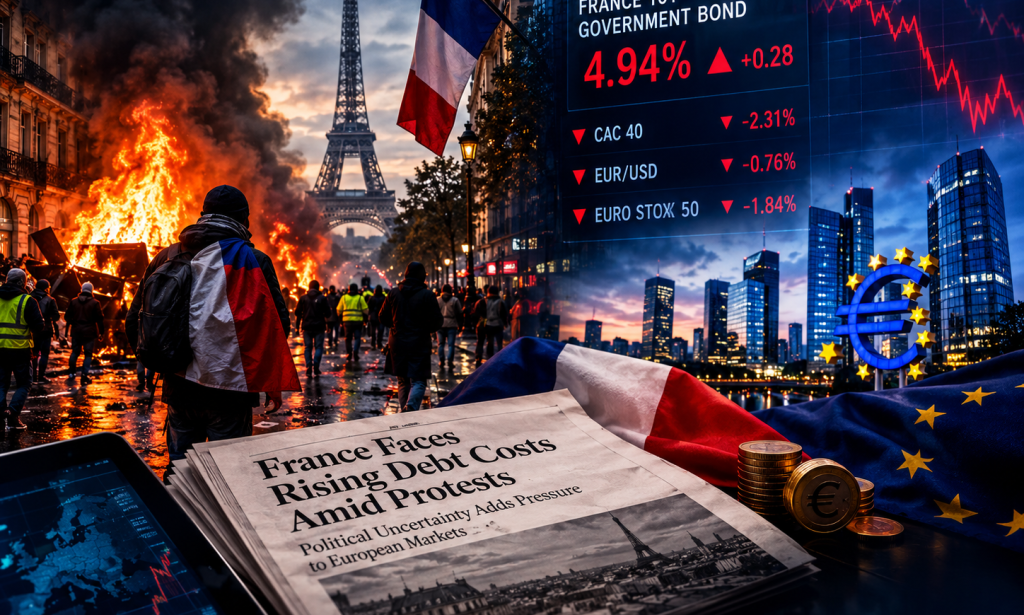
The yield on France’s benchmark 10-year government bond climbed as high as 4.94%, with the yield around 4.89% later in the day. Higher yields mean the French government must pay more to borrow money, increasing the pressure on already-stretched public finances.
That matters because France is not a small economy that can simply ignore higher borrowing costs.
It is one of Europe’s largest economies, and its government is already dealing with a significant budget deficit and a difficult political environment.
The unrest therefore creates a dangerous feedback loop:
Political instability → weaker investor confidence → higher borrowing costs → greater pressure on government finances → even harder political decisions.
And markets tend to move faster than governments.
The hidden victim: French businesses
The immediate economic damage is also becoming impossible to ignore.
More than 1,500 businesses have reportedly been affected by the unrest, ranging from major retailers to smaller independent shops. Some companies have temporarily closed locations, while others are facing losses from damage, theft and reduced customer activity.
For a large corporation, one damaged store may be an accounting problem.
For a small business, it can be an existential one.
And there is another cost that does not always appear in the first headlines: lost consumer confidence.
If shoppers avoid city centres, businesses close earlier and companies postpone investment because they are uncertain about what comes next, the economic damage can continue long after the streets become quiet.
Then comes the euro
The pressure has not been limited to French assets.
The euro also weakened as investors assessed the political and fiscal uncertainty surrounding France. European shares were under pressure, with French stocks among the hardest hit.
This is where France’s problems become Europe's problems.
France shares the euro with 19 other countries. Investors therefore cannot always treat a French crisis as an isolated event.
If confidence in one of the eurozone's largest economies deteriorates sharply, investors can begin asking a much bigger question:
Could political instability and high government debt become a broader European problem?
That is the risk markets are watching.
France’s debt problem makes everything more sensitive
The timing could hardly be more uncomfortable for the French government.
France is already facing intense pressure over government spending, its budget deficit and its ability to convince investors that public finances can be brought under control. The country is also approaching an important political period, making difficult spending decisions even more complicated.
The protests add another layer.
Cut spending too aggressively and the government risks angering citizens who are already struggling with the cost of living.
Spend more to calm the population and the government risks making its fiscal position even harder to manage.
That is the trap.
France needs to reassure both its citizens and the financial markets — but those two audiences may not want the same thing.
Why investors should pay attention
This is not necessarily a prediction that France is heading toward a financial crisis.
Markets fall, currencies weaken and bond yields rise for many reasons. France also has substantial economic resources and remains one of the world's major economies.
But the combination of social unrest + political uncertainty + high debt + expensive borrowing is exactly the type of mixture that investors monitor closely.
The bond market is particularly important because government borrowing costs influence the price of financing across the economy.
If the government's cost of borrowing stays elevated, pressure can eventually spread into banks, businesses, consumers and public spending.
That is why the most interesting chart from France right now may not be a photograph of a burning street.
It may be a chart showing the country's borrowing costs.
And this is where the story gets bigger
France is not experiencing economic frustration in isolation.
Across Europe, protests have increasingly been linked to the same uncomfortable themes: expensive housing, higher energy costs, stagnant purchasing power and dissatisfaction with public services.
That creates a question far more significant than what happens in Paris tonight:
Are these protests individual national crises — or symptoms of a deeper European affordability problem?
If governments across Europe are forced to spend more to protect households while simultaneously trying to control debt, investors could face a very different European economic landscape.
And that is why France's unrest deserves attention from more than political observers.
It deserves the attention of anyone watching bonds, equities, currencies and the future of the European economy.
The Bottom Line
The riots may eventually disappear from the front pages.
The economic consequences could take considerably longer.
France now faces the difficult task of restoring order on the streets while restoring confidence in its finances.
For investors, the question is no longer simply “What is happening in France?”
It is:
“How expensive will it become to keep France running?”


You must be logged in to post a comment.